

-
Maximize Fluorescence Performance for Up to 40% More Signal in High-Sensitivity Imaging Systems
Oct 23, 2025 by IDEX Health & ScienceEach member of the Avant™ Filter Set Family provides significant improvement in fluorescence performance for its corresponding short Stokes Shift fluorophore. Find the rationale behind this development, and how it was achieved.
Full story
-
Lot-to-lot Consistency with Semrock Optical Filters
Sep 19, 2025 by IDEX Health & ScienceWhat's the real difference between a filter's advertised performance and what's actually delivered? The answer lies in lot-to-lot consistency. You might have seen advertised specifications with impressive spectral curves, but how do you know if the filter you receive will match those promises? Explore our answer here.
Full story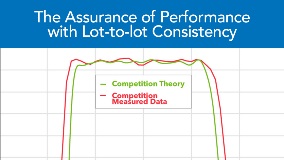
-
What's Your Spectral Challenge?
Aug 26, 2025 by IDEX Health & ScienceTo overcome the obstacles many fluorescence instrument designers and users face with spectral management, our experts created SearchLight. Can’t find the right fluorophore? Struggling with filter selection? Don't have time to set up custom models? We have a solution to these spectral challenges (and more). Click to read more.
Full story
-
Emission Filters for Single-point Measurements
Aug 20, 2025 by IDEX Health & ScienceA single-point fluorescence detector measures the total integrated signal independent of the spatial light distribution. The most important filter specifications to consider are the levels and ranges of the transmission and blocking regions. If only a single fluorophore is to be used, a long-wave-pass filter rather than a bandpass filter can be used to maximize signal. However, this usually increases noise (background signal) even more, so is not an optimal choice. Read more here.
Full story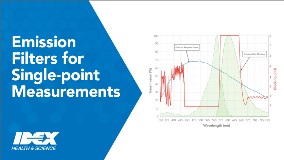
-
Case Study: Improved Fluorescence Detection Performance with an Avant™ Filter Set
Aug 1, 2025 by IDEX Health & ScienceMany of the most useful fluorescent probes have small separations between their peak excitation and emission wavelengths. These so-called small Stokes Shift probes have presented a historical challenge to optical filter manufacturers, because the critical edges of the passbands could not be placed too close together, at risk of overlap due to filter manufacturing variability. Read for IDEX Health & Science's solution!
Full story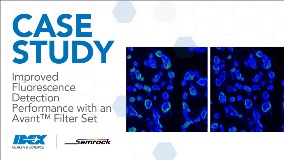
-
The Science of Sight: Intro to Tristimulus Filters
Jun 13, 2025 by IDEX Health & ScienceEver wonder how the vibrant colors on your screen or the perfect shade of paint on your wall are precisely measured and maintained? The secret lies in a critical, yet often unseen, component: tristimulus optical filters. Read our "The Science of Sight: Intro to Tristimulus Filters" to learn more!
Full story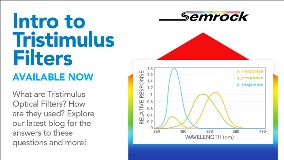
-
We’re An Optical Engineer’s Best Friend
May 19, 2025 by IDEX Health & ScienceWhen you need experts in optical systems and high-volume thin film filters, IDEX Health & Science is there with on-time delivery, guaranteed product performance, responsiveness with issues, and collaborative solutions.
Full story
-
Custom vs Catalog Semrock Optical Filter Options
May 16, 2025 by IDEX Health & ScienceDeciding on a set of optical filters for a new fluorescence-based product is a complex task that requires careful planning to assure a successful outcome. Complicating factors include the need for fast timeline, reliable production, and budget constraints. IDEX Health & Science has empowered this search process with its line of Semrock® optical filters.
Full story
-
Key Factors That Determine Laser Damage Threshold (LDT)
May 15, 2025 by IDEX Health & ScienceLaser damage to optical filters is strongly dependent on many factors, and thus it is difficult to guarantee the performance of a filter in all possible circumstances. LDT is typically specified in units of Joules/cm2. Read this blog to explore factors important to determining LDT.
Full story
-
Limitations of Spectral Measurements
May 6, 2025 by IDEX Health & ScienceSpectral measurements of filters using standard spectrometers suffer from a few limitations, especially when attempting to measure very steep edges and sharp transitions. Read this blog to learn more!
Full story