
Stories & Features

As imaging systems continue to evolve, OEM developers face increasing pressure to acquire more data while maintaining image quality, reliability, and throughput.
Whether the application involves machine vision, semiconductor inspection, clinical diagnostics, digital pathology, automated microscopy, line-scan inspection, or other advanced imaging platforms, the ability to capture high-quality images at speed has become a major competitive advantage.
Meeting these demands requires more than selecting the right camera or choosing a powerful illumination source. The IDEX Health & Science engineering team behind Melles Griot optical solutions works with OEM developers to integrate illumination, imaging, and autofocus technologies into cohesive optical subsystems that support high-throughput performance across a variety of imaging applications.
Increasing throughput is rarely achieved by improving a single subsystem.
Illumination affects exposure time. Imaging optics affect image quality. Autofocus determines how quickly a system can acquire and maintain focus as samples, parts, or fields of view change. Together, these technologies determine how efficiently an imaging system can operate.
As performance expectations increase, OEM developers often discover that optimizing subsystems independently can create bottlenecks elsewhere in the system.
By considering illumination, imaging, and autofocus together from the beginning of development, engineers can improve overall system performance while reducing integration risk. This systems-level approach is central to how Melles Griot solutions support customers developing complex imaging instruments and optical subsystems.
No matter how advanced the imaging platform, useful data depends on one fundamental requirement:
The image must be in focus.
"If your imaging, illumination and autofocus conjugates are not all in co-focus, then you don't get the imaging resolution or field-of-view that you need," explains James Letterneau, Sr. Engineering Manager at IDEX Health & Science.
In many imaging systems, maintaining focus becomes increasingly difficult as imaging speeds increase. While traditional focus methods rely on image-based autofocus, demands for faster speeds and higher throughput have shifted the technology towards laser-based autofocus methods.
Additionally, being “in focus” is not always as simple as measuring or controlling a single parameter. Samples may vary in position or orientation (tilt), stages may move rapidly, or other instrument level factors may introduce mechanical and thermal variation.
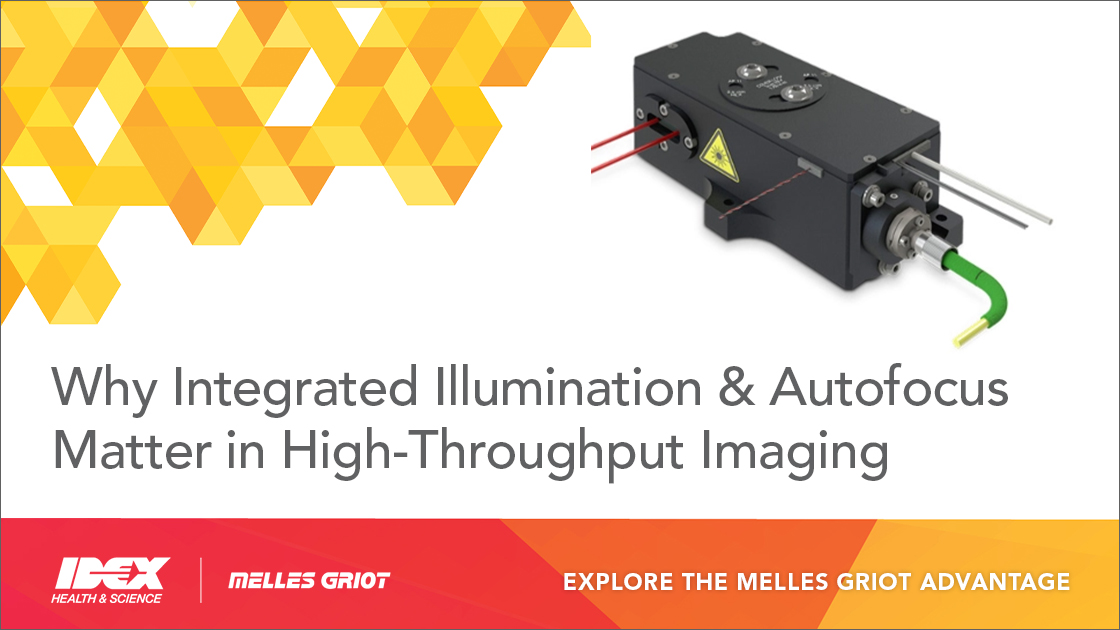
Laser autofocus systems, carefully planned by the IDEX Health & Science team and tailored to the specific platform, can help overcome these challenges by continuously monitoring focus and making corrections in real time.
Explore Laser Autofocus System
Traditional image-based autofocus determines focus by analyzing camera images.
While this approach can be effective, it also requires image acquisition, camera readout, and processing before focus corrections can be made. As imaging speeds increase, this process can become a limiting factor.
Our Melles Griot laser autofocus system takes a different approach.
Rather than evaluating captured images, a dedicated laser beam continually monitors focus position through a separate optical path. This allows focus measurements to be performed much more rapidly than image-based methods.
Because focus data can be acquired faster, laser autofocus supports:
The benefits are especially valuable in applications where systems must continually acquire images while maintaining tight focus tolerances.
Examples include:
Combining laser autofocus with Melles Griot illumination expertise enables OEM developers to improve throughput while maintaining image quality and focus stability.
One of the most common challenges OEM developers face occurs when illumination, imaging, and autofocus technologies are developed independently.
Each subsystem may meet its individual specifications, yet the complete system still experiences integration issues. Engineers often discover alignment challenges, focus-plane mismatches, or performance limitations only after final assembly.
"The main challenge when they're developed independently is how do you align them in the top-level system?" says Letterneau.
That question can significantly impact development schedules and implementation risk.
When subsystems are designed together, engineers can account for these interactions upfront rather than attempting to solve them later.

High-performance imaging systems depend on more than individual components.
Optical coatings, filters, illumination sources, polarization effects, imaging requirements, and autofocus architectures all influence overall system performance. Optimizing one subsystem in isolation may unintentionally create challenges for another. Co-development helps create a more optimized solution by ensuring these variables are evaluated together throughout the design process.
Benefits of an integrated approach include:
Rather than optimizing individual subsystems, the focus becomes optimizing the instrument as a whole.
The demand for faster imaging continues to grow.
Applications across industrial inspection, diagnostics, life science research, machine vision, and semiconductor manufacturing increasingly require larger fields of view, higher acquisition speeds, and greater automation.
Meeting those demands requires more than higher illumination power or faster cameras. It requires a coordinated system architecture that allows illumination, imaging, and autofocus technologies to work together efficiently.
By treating these technologies as integrated subsystems rather than independent components, the our team helps OEM developers create imaging platforms that deliver higher throughput, improved image quality, and a lower-risk path to commercialization.
Integrated illumination and autofocus solutions are subsystems designed to work together within a larger imaging platform. Coordinating these technologies can improve image quality, simplify integration, and support higher throughput operation.
Developing illumination, imaging, and autofocus subsystems together allows engineers to address alignment, optical performance, and integration requirements early in the design process, reducing risk and improving overall system optimization.
Laser autofocus is a focus-control technology that uses a dedicated laser beam and sensor to continuously monitor focus position. Because it operates independently of the imaging path, it can provide faster focus measurements than image-based approaches.
Image-based autofocus relies on image acquisition and processing to determine focus. Laser autofocus measures focus position using a dedicated optical path and sensor, enabling faster updates and improved throughput.
Integrated illumination and autofocus solutions are used in machine vision, semiconductor inspection, clinical diagnostics, digital pathology, automated microscopy, DNA sequencing, spatial biology, high-content screening, and other high-throughput imaging systems where focus stability and illumination performance directly impact throughput and image quality.
Developing illumination and autofocus systems together can improve image quality, reduce alignment challenges, simplify integration, enhance autofocus performance, and support higher overall system throughput.
Yes. Melles Griot supports OEM customers with custom optical subsystem development that may include illumination technologies, beam-shaping optics, autofocus solutions, and application-specific integration requirements designed to support high-performance imaging systems.
Important considerations include focus accuracy, update speed, thermal stability, sample tilt sensitivity, alignment requirements, and compatibility with the overall imaging system architecture.
Whether you're evaluating LEDs, laser diodes, or a hybrid approach, Melles Griot optical solutions from IDEX Health & Science can help you navigate the performance tradeoffs and develop an illumination architecture tailored to your application's requirements.
Because the best light source is ultimately the one that delivers the right photons to the right place, as efficiently as possible.
Each edition explores how to design, optimize, and scale high-performance optical systems.
New to the series? Catch up on our previous installments:
Have a question or system in mind?