
Stories & Features

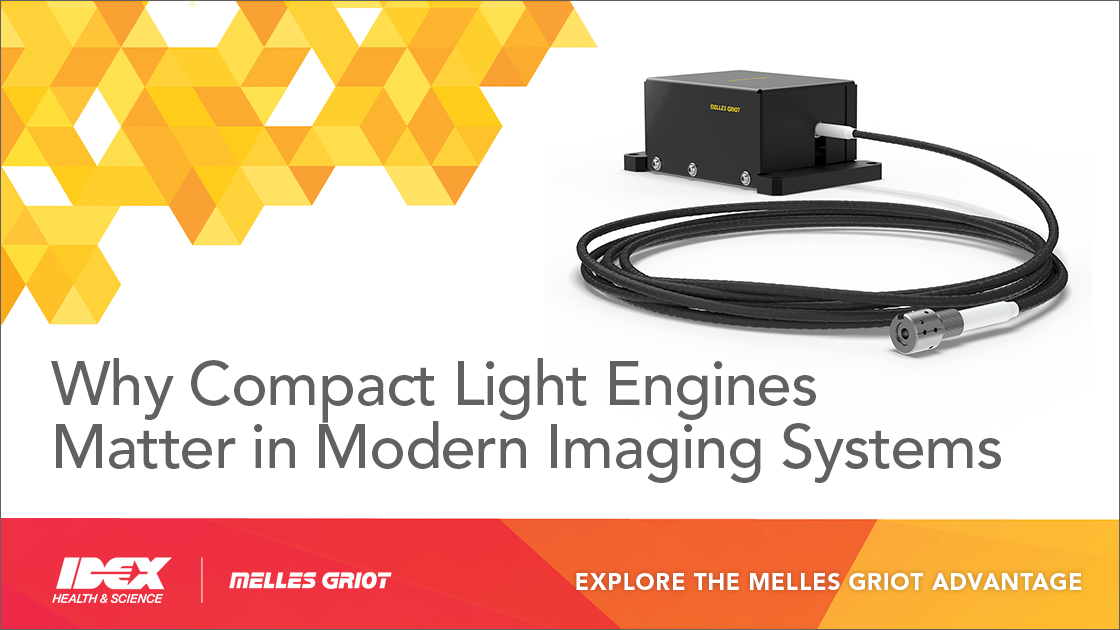
Modern imaging instruments are becoming faster, more automated, and increasingly compact. Whether your application involves industrial inspection, semiconductor metrology, machine vision, digital pathology, clinical diagnostics, DNA sequencing, or advanced fluorescence microscopy, instrument developers need illumination systems that deliver exceptional optical performance while fitting within increasingly constrained footprints.
A compact OEM light engine helps solve this challenge by integrating lasers, optics, electronics, thermal management, and optical delivery into a single subsystem that can be incorporated directly into an imaging instrument. Rather than requiring developers to source and integrate individual components themselves, a compact light engine provides a tailored illumination solution optimized for a specific application.
One of the easiest ways to understand the role of illumination in an imaging system is to think about a camera.
"Think of today's imaging instruments as highly sophisticated cameras, with the laser acting as the flash bulb."
- Dave Hargis, CTO of Engineering, IDEX Health & Science
In this analogy, the illumination system provides the light needed to capture meaningful information from a sample or target. Whether an instrument is imaging biological tissue, sequencing DNA, inspecting semiconductor wafers, or scanning products on a manufacturing line, the challenge is the same: deliver the right amount of light, in the right place, with the right characteristics to produce reliable imaging results.
A compact OEM light engine is much more than a collection of lasers.
A well-designed light engine typically integrates:
These elements must work together to provide stable, repeatable illumination that can be easily incorporated into the customer's instrument. Thermal management is particularly important because excessive heat can impact optical performance, stability, and long-term reliability. Our engineers use sophisticated structural, thermal, and optical performance analysis to predict how high-power illumination systems will behave under operating conditions.
Raw laser output is rarely ready for direct use in an imaging system.
Without optical conditioning, laser light may contain non-uniform intensity distributions, speckle artifacts, and beam profiles that do not align with the needs of the application. Our Melles Griot optical system engineers often transform this raw output into highly uniform illumination patterns optimized for imaging performance.
The goal is simple: put light where the customer wants it, with the characteristics they need for their application.
This may involve creating:
By tailoring the illumination profile to the imaging system, developers can improve signal quality, reduce noise, and maximize measurement consistency.
One of the most common requirements OEM developers bring to IDEX Health & Science is illumination uniformity. Many imaging applications require highly consistent illumination across the entire field of view. Variations in brightness can create image artifacts, introduce measurement variability, and impact the quality of acquired data.
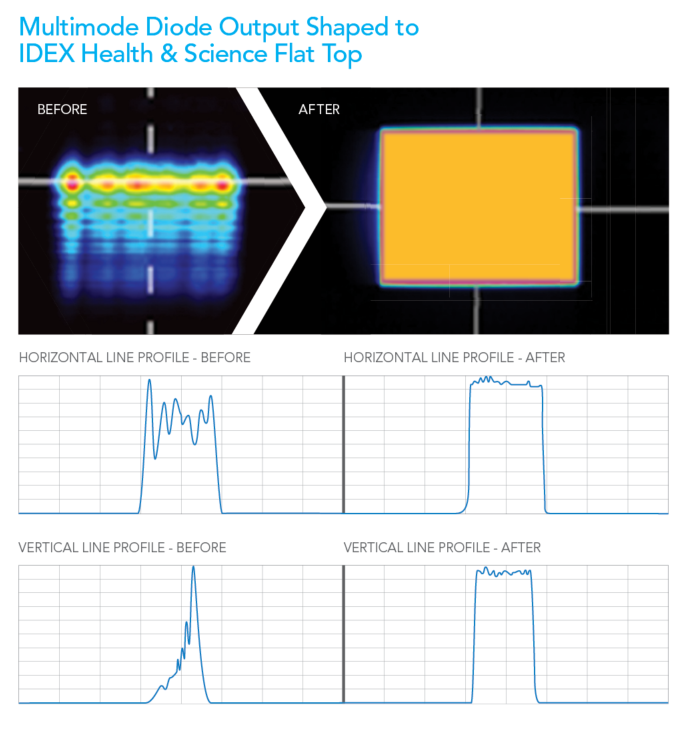
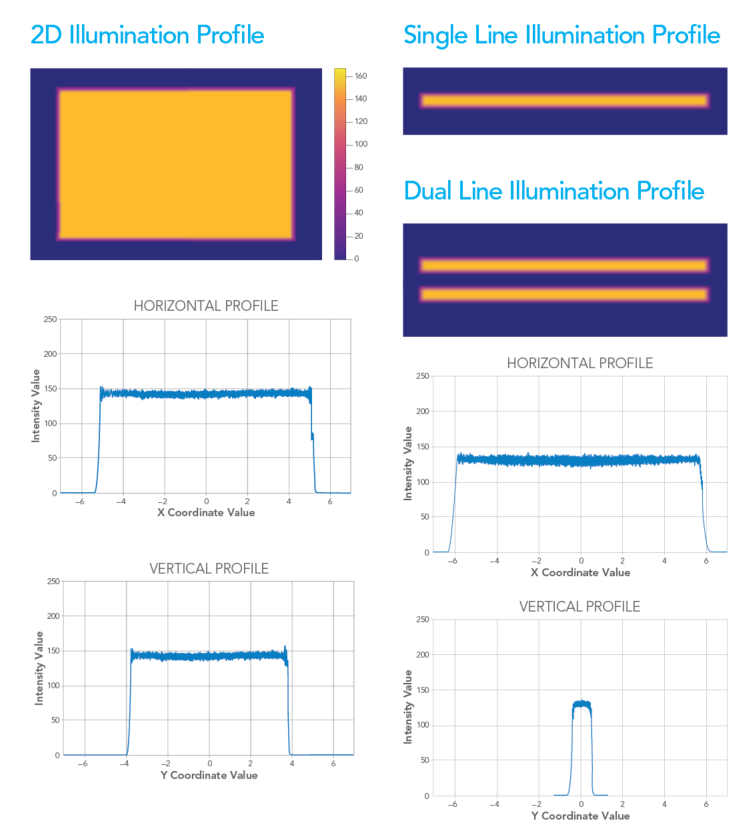
Engineers often describe the desired result as a flat-top illumination profile, which maintains a highly uniform intensity across the area being imaged. Achieving that result requires careful beam shaping and optimization of profile edges, uniformity, and speckle performance.
As acquisition speeds increase and exposure times decrease, controlling illumination uniformity becomes even more important. High-speed imaging systems can become increasingly sensitive to speckle noise, making illumination quality a critical part of overall system performance.
Compact OEM light engines support a wide range of imaging platforms beyond traditional microscopy applications.
Applications include:
While the imaging challenges vary across markets, the underlying illumination requirements remain remarkably similar: stable optical power, uniform illumination, compact packaging, low noise, and reliable system performance.
Another major trend across imaging markets is the demand for higher throughput.
OEM developers are increasingly seeking higher illumination power, larger fields of view, and multi-wavelength imaging capabilities. Engineers noted growing demand for multi-watt illumination systems capable of helping customers acquire more data, inspect more products, and process more samples in less time.
Higher optical power can reduce the exposure time needed to capture an image while maintaining signal quality. This allows imaging systems to collect data more quickly and efficiently.
From line-scan industrial inspection systems to clinical diagnostic platforms and automated imaging systems, faster image acquisition often translates directly into greater throughput and shorter processing times.
Many instrument developers initially consider sourcing individual lasers, optics, electronics, and cooling components separately. However, integrating and optimizing those elements can become a significant engineering challenge.
A custom OEM light engine simplifies integration while providing a solution optimized for the application's specific requirements.
Benefits can include:
Compact packaging is often a significant advantage. Compared with larger laboratory-style illumination systems, OEM-focused light engines can be designed specifically to fit within stringent instrument space constraints while still delivering the necessary optical performance.
Successful illumination design is rarely about maximizing every possible specification.
Instead, engineers strive to balance performance, manufacturability, reliability, and cost. A solution that exceeds requirements may add unnecessary complexity, while one that falls short may limit instrument performance.
The most effective OEM illumination systems are carefully tailored to the application's needs, providing exactly the illumination performance required to achieve reliable imaging results while supporting scalable manufacturing and long-term success.
For decades, OEM developers have partnered with Melles Griot for custom illumination solutions that help simplify integration and improve instrument performance. By combining expertise in lasers, beam shaping, thermal management, and optical subsystem design, Melles Griot helps customers create illumination systems optimized for demanding life science and imaging applications.
Whether the goal is a compact OEM light engine, a high-power illumination subsystem, or a custom beam-shaping solution, successful illumination design begins with understanding exactly what the instrument needs and engineering a solution specifically for that purpose.

What is a compact OEM light engine?
A compact OEM light engine is an integrated optical subsystem that combines laser sources, optics, thermal management, electronics, and optical delivery into a single package. It is designed to provide application-specific illumination that can be easily integrated into an OEM imaging instrument.
Why do OEMs choose a custom light engine instead of building their own?
Building an illumination system from individual lasers, optics, electronics, and cooling components can add significant engineering complexity. A custom light engine simplifies integration by providing a tailored solution optimized for the instrument's performance, footprint, and reliability requirements.
How does beam shaping improve imaging performance?
Beam shaping modifies the size, shape, and intensity distribution of light so it matches the imaging application's requirements. This helps create illumination profiles that improve image consistency, reduce unwanted artifacts, and maximize optical efficiency.
FAQ: Why is illumination uniformity important?
Many imaging applications require consistent illumination across the entire field of view. Uniform illumination helps improve measurement repeatability, image quality, and quantitative analysis by reducing intensity variations across the sample.
FAQ: How does illumination affect system throughput?
Higher illumination power can reduce the camera exposure time required to capture an image. Shorter exposure times enable faster image acquisition, allowing instruments to process more samples and generate results more quickly.
Each edition explores how to design, optimize, and scale high-performance optical systems.
New to the series? Catch up on our previous installments:
Have a system in mind? Explore how a custom optical system can improve performance and reduce total cost over time.