
Stories & Features

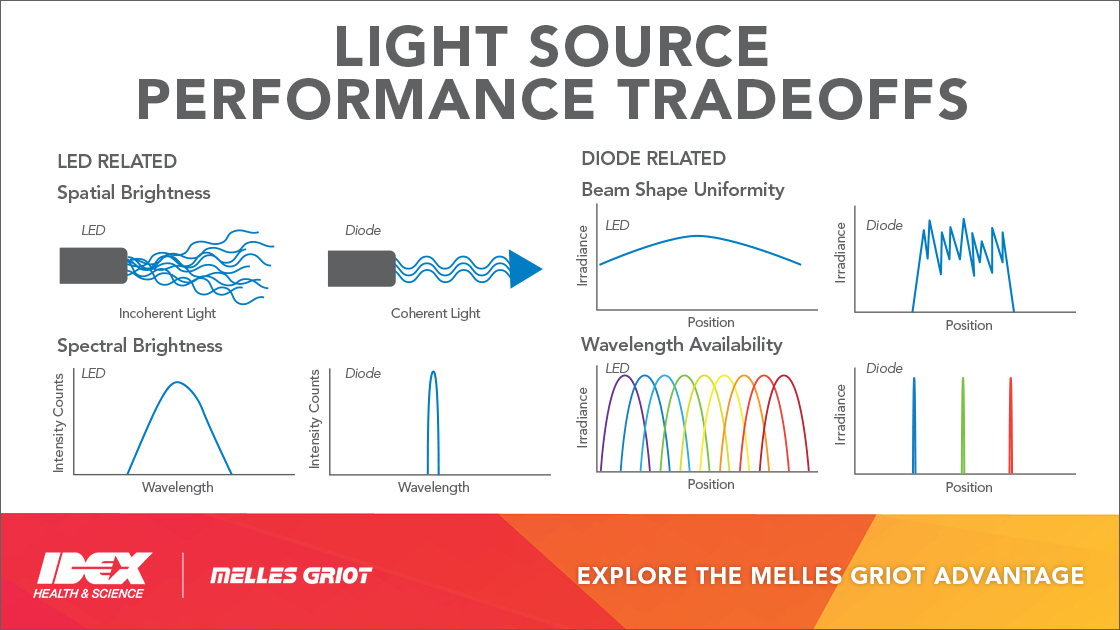
When designing fluorescence imaging, flow cytometry, molecular diagnostics, or analytical instrumentation systems, choosing between an LED and a laser diode is rarely a straightforward decision. Each technology offers distinct performance advantages, but each also introduces optical challenges that can impact system sensitivity, image quality, throughput, thermal management, and overall complexity.
For many engineers, the more important question is not whether an LED or laser diode is inherently better, but how to maximize the performance of the selected source within the complete optical system. At IDEX Health & Science, Melles Griot optical solutions help instrument developers overcome the limitations of both illumination technologies through integrated expertise in illumination design, beam shaping, optical filtering, imaging optics, and subsystem integration. Rather than treating the light source as an isolated component, Melles Griot helps engineers optimize the entire optical path to achieve higher performance, improved reliability, and faster time to market.
Selecting an LED or laser diode is only one part of illumination system design. Equally important is how efficiently that light is collected, conditioned, delivered, and managed throughout the optical path.
Melles Griot optical solutions help address common illumination challenges through:
By optimizing the complete optical architecture, we help engineers reduce tradeoffs between performance, system complexity, footprint, and cost while maximizing usable photons at the point of measurement.
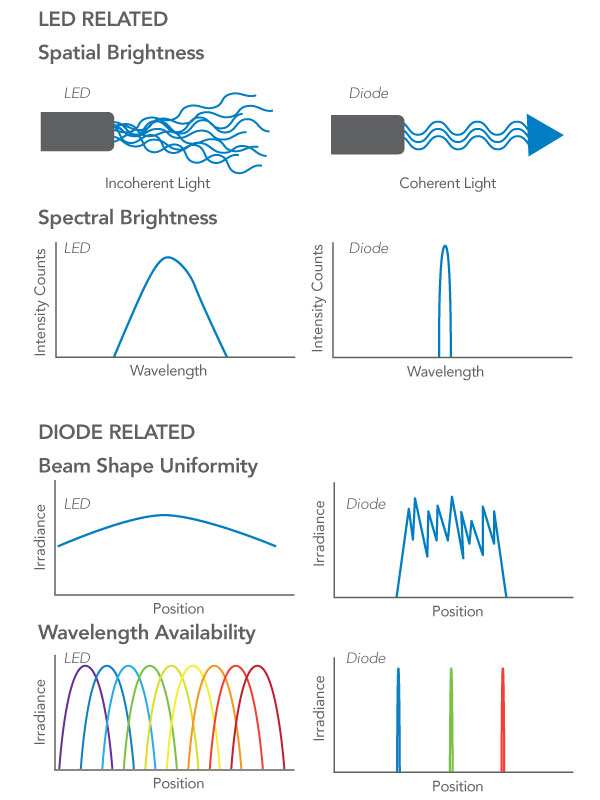
One of the biggest differences between LEDs and laser diodes is how efficiently they deliver usable photons to the imaging plane. The ability to collect, shape, and direct light often determines overall system performance as much as the source itself.
LEDs generate light over a relatively large emitting area and emit light incoherently across many angles. While LEDs offer broad wavelength options and excellent cost-effectiveness, much of the emitted light can be difficult to collect and focus efficiently into an optical system.
As a result:
LEDs also exhibit broader spectral output than laser diodes. For instruments requiring highly selective excitation wavelengths, additional filters and dichroic elements may be necessary to isolate the desired spectral band.
Laser diodes provide significantly higher spatial and spectral brightness. Their coherent, highly directional output allows optical systems to efficiently deliver more photons exactly where they are needed.
This can enable:
However, these benefits introduce their own challenges, particularly around beam quality and coherence effects.
The answer depends on the application, but for many analytical and life science instruments, every photon counts.
When optical systems lose light through inefficient collection, filtering, or beam delivery, manufacturers often compensate with:
These workarounds can increase both system complexity and cost.
Rather than simply increasing source power, Melles Griot optical solutions focus on maximizing the efficiency of the entire optical path. Through optimized collection optics, precision alignment, illumination delivery architectures, and integrated subsystem design, engineers can often achieve required performance with fewer compromises.
Benefits can include:
For optical systems engineers, improving photon utilization is often a more effective path to better performance than simply choosing a brighter light source.
LEDs offer many advantages, but achieving higher output power often requires increasing drive currents, which generates heat.
As optical power increases:
In compact instruments, thermal considerations can become a major design driver.
Rather than treating thermal management as a standalone mechanical challenge, our team considers thermal performance as part of the complete optical architecture. By balancing illumination efficiency, optical throughput, source selection, and packaging requirements, engineers can achieve desired performance while minimizing thermal burden throughout the system.
One of the most common challenges associated with laser diodes is beam uniformity.
Because lasers are coherent sources, they can produce:
These effects can be problematic for imaging applications where uniform illumination directly impacts measurement accuracy.
Without proper beam conditioning, coherent artifacts may appear as noise or image distortions, reducing overall instrument performance.
This is where optical expertise becomes crucial. Managing laser coherence effects requires more than selecting a laser with the right power and wavelength. It requires sophisticated optical engineering that conditions and reshapes the beam for the application's requirements.
Melles Griot solutions incorporate advanced beam-shaping and homogenization approaches that help transform highly structured laser output into illumination profiles more suitable for demanding analytical and imaging applications.
The result is:
For many high-performance imaging systems, beam conditioning is ultimately what determines whether laser illumination achieves its full potential.
Different applications often require specific excitation wavelengths to target particular fluorophores, biomarkers, or analytical techniques.
LED technology is available across a wide range of wavelengths, making it attractive for multi-channel systems and emerging assay designs.
Laser diodes offer exceptional spectral precision, but wavelength availability may be limited depending on application requirements. Designers sometimes must balance desired performance against commercially available laser wavelengths.
The optimal solution isn't always choosing LEDs or lasers exclusively. Many advanced instruments successfully combine multiple source technologies to maximize performance while controlling complexity and cost.
Melles Griot's deep experience across illumination, optics, filtering, and system integration allows developers to evaluate the complete optical architecture rather than focusing solely on the source itself.
| Engineering Challenge | Melles Griot Solution |
|---|---|
| Poor LED photon utilization | High-efficiency collection optics and optimized light delivery architectures. |
| Non-uniform laser illumination | Advanced beam shaping and homogenization technologies |
| Speckle and interference artifacts | Precision optical conditioning designed to improve illumination quality. |
| Thermal constraints | Integrated optical and mechanical design that balances performance and thermal efficiency. |
| Wavelength-specific application requirements | Expertise across illumination, filtering, and subsystem integration. |
| Excessive system complexity | Fully integrated optical subsystems designed to simplify implementation and accelerate development. |
Download our Illumination 101 Guide
The real question is often not whether LEDs or laser diodes are better.
The better question is:
How can the optical system be designed to maximize the strengths of each source while minimizing their weaknesses?
At IDEX Health & Science, Melles Griot optical solutions provide expertise across illumination, beam shaping, optical filtering, imaging optics, and subsystem integration to help instrument developers address challenges such as:
By approaching illumination as part of a complete optical system rather than an isolated component decision, developers can unlock higher performance, faster time to market, and more reliable analytical results.
Whether you're evaluating LEDs, laser diodes, or a hybrid approach, Melles Griot optical solutions from IDEX Health & Science can help you navigate the performance tradeoffs and develop an illumination architecture tailored to your application's requirements.
Because the best light source is ultimately the one that delivers the right photons to the right place, as efficiently as possible.
Each edition explores how to design, optimize, and scale high-performance optical systems.
New to the series? Catch up on our previous installments:
Have a system in mind? Explore how a custom optical system can improve performance and reduce total cost over time.