
Stories & Features

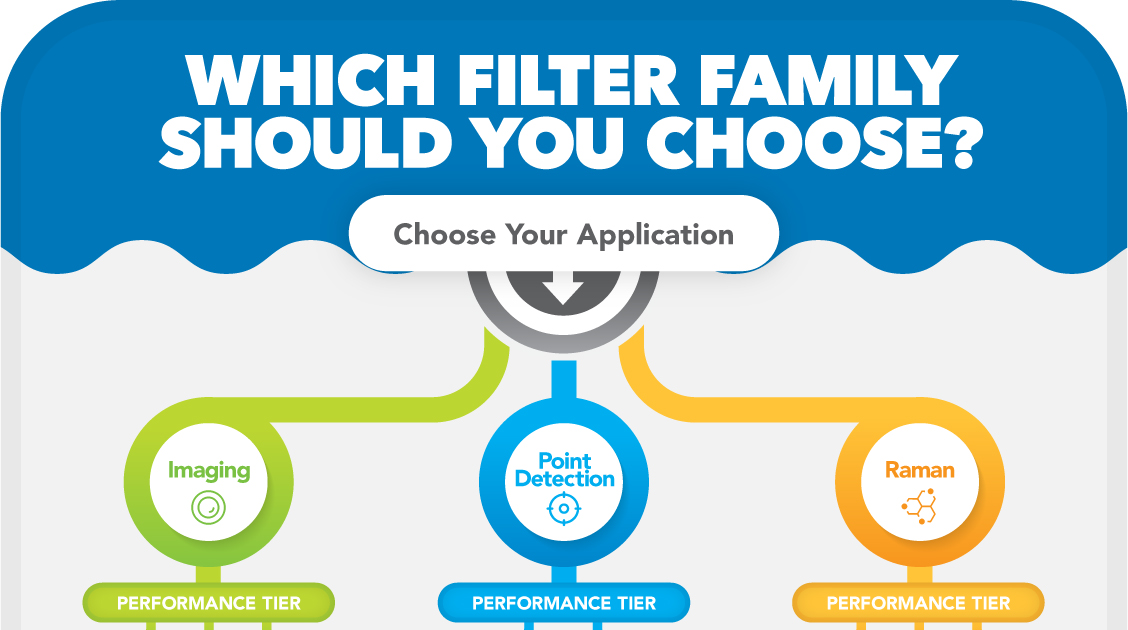
Learn how to choose the right optical filters for your application and compare Semrock filter families including BrightLine Basic™, Nanopede™, EdgeBasic™, BrightLine®, BrightLine® 2.0, Avant™, RazorEdge™, and Verona™.
Optical filters shape performance in fluorescence imaging, flow cytometry, Raman spectroscopy and biomedical analytical systems. Filter selection directly impacts how much signal light reaches the detector, how effectively unwanted light is suppressed, and how cleanly spectral channels are separated from each other.
However, not all optical systems require the same level of filter performance. At IDEX Health & Science, our Semrock optical filters are intentionally engineered across well-defined performance tiers based upon your application needs. This tiered approach enables selecting filters that meet application requirements without adding unnecessary cost or complexity. Whether you need essential performance, maximum signal, or maximum contrast, selecting the right performance level ensures your system performs as intended.

Across all Semrock filter families, performance is driven by three core spectral criteria:
Performance tradeoffs result in two primary product tiers:- Essential Performance filters prioritize reliable, application‑matched performance with relaxed specifications that reduce cost.
- High Performance filters are engineered to maximize brightness or contrast, delivering higher signal‑to‑noise ratios for demanding imaging and detection tasks.
| If your application requires... | Recommended filter family | Why |
| Cost-conscious fluorescence imaging with dependable performance | BrightLine Basic | Optimized specifications for general imaging applications at a lower cost |
| Spectral flow cytometry or other non-imaging detection systems | Nanopede | Designed specifically for point detector-based measurements |
| General fluorescence imaging with legacy illumination sources | BrightLine | Proven imaging performance with broad market adoption |
| Modern LED- or laser-based fluorescence imaging with high contrast | BrightLine 2.0 | Enhanced transmission, blocking, and spectral efficiency for modern imaging systems |
| Short Stokes shift fluorophores such as mCherry, YFP, or Cy5.5 with high brightness | Avant | Ultra-steep spectral edges enable maximum signal collection |
| Weak Raman signal detection requiring reliable performance | EdgeBasic, RazorEdge, MaxLine and Verona | Solutions available across Essential and High Performance tiers depending on spectral requirements |
Not sure where to start?
Talk to one of our application scientists!
Essential Performance optical filters are designed for applications that do not require the most demanding spectral specifications but still need consistent, reliable optical behavior.
This tier is well‑suited for:
By selectively relaxing specifications that are not critical to system performance, Essential Performance filters balance performance without compromising Semrock quality or reliability.
BrightLine Basic sets are engineered specifically for fluorescence imaging applications that benefit from standardized specifications and simplified selection. These sets have relaxed spectral requirements to meet common fluorophore needs at a lower cost while remaining versatile and budget-friendly with Semrock quality. BrightLine Basic is the only imaging set offered within the Essential Performance tier.
EdgeBasic long‑wave pass and short‑wave pass filters are optimized for Raman spectroscopy and selected fluorescence applications. They provide deep laser‑line blocking and high transmission, but their relaxed transition widths will not allow measurement of the narrowest Raman shifts or ultra‑steep spectral transitions.
Nanopede bandpass filters are designed for non‑imaging, point-based detection applications, such as spectral flow cytometry. They offer discrete, evenly spaced spectral coverage across UV, visible, and near‑infrared spectral regions, supporting flexible detection configurations.
Across Essential Performance families, filters are designed to deliver:
High Performance optical filters are engineered for applications where signal quality and / or signal-to-noise ratio is paramount. These filters are optimized for modern imaging systems that require high brightness, high contrast, and precise spectral separation when multiplexing.
This tier addresses challenges such as:
High Performance families provide increased transmission, deeper and broader blocking, and steeper spectral edges, delivering darker backgrounds and thus higher signal‑to‑noise ratios.
The BrightLine family established Semrock hard‑coated filter technology in life science applications. Known for durability, spectral reliability, and repeatable edge placement, BrightLine sets remain a proven solution for general fluorescence imaging.
BrightLine is the only filter family offering multi-band sets for multiplexing applications, including full multi-band, Pinkel, and Sedat sets.
BrightLine 2.0 builds on the BrightLine legacy with enhanced specifications tailored for modern imaging workflows. These sets combine improved blocking and higher transmission with broader compatibility across current and legacy light sources and detectors, offering a strong balance of performance and versatility.
Avant filters represent Semrock’s highest level of spectral edge engineering. Designed to minimize the gap between excitation and emission passbands, Avant sets enable higher brightness (signal) for fluorophores with short Stokes shifts. Ultra‑steep edges at precisely placed wavelengths allow excitation closer to absorption peaks while collecting more emission light without sacrificing contrast.
Semrock stocks an unsurpassed selection of the highest performance edge filters available for Raman Spectroscopy, with edge wavelengths from 224 to 1319 nm. Now you can see the weakest signals closer to the laser line than you ever have before with optical filter technology. With their deep laser-line blocking, ultra-wide and low-ripple passbands, proven hard-coating reliability, and high laser damage threshold, they offer performance that lasts. Short-wave-pass edge filters are also available for Anti-Stokes Raman applications.
The unique RazorEdge Dichroic beamsplitters exhibit unparalleled performance, reflecting a standard laser line incident at 45° while efficiently passing the Raman-shifted wavelengths. They exhibit ultrasteep transition from reflection to transmission, far superior to filters available elsewhere. The guaranteed transition width of < 1% of the laser wavelength for U-grade and < 0.5% of the laser wavelength for E-grade (regardless of polarization) makes these filters a perfect match to our popular normal-incidence RazorEdge ultrasteep long-wave-pass filters.
Semrock MaxLine Laser-Line Filters guarantee > 90% transmission at the laser line, while maintaining a narrow full-width, half-maximum (FWHM) by rapidly rolling off to an optical density of > 5 at wavelengths differing by only 1% from the laser wavelength, with OD > 6 at wavelength differing by only 1.5% from the laser wavelength. These steep edges create the perfect match to RazorEdge U-grade filters. For E-grade RazorEdge filters, new and steeper MaxLine E-grade filters increase the edge steepness, resulting in the perfect pairing for Raman signal collection even closer to the laser line.
The MaxLine filter spectrally “cleans up” the laser, allowing only the desired laser light to reach the sample. The RazorEdge U- or E-grade filter then removes the laser line from the light scattered off the sample while efficiently transmitting desired light at wavelengths close to the laser line.
Semrock’s long-pass Verona optical filters provide industry-best solutions for deep blocking close to the laser line for Raman applications. The transition width of no more than 0.2% relative to the edge wavelength still achieves blocking > OD6 at the laser line. Our understanding of how crucial constant transmission is for the best collection of weak Raman signals is why we offer a filter with both low ripple and improved steepness from our RazorEdge™ series, making the Verona family the new gold standard for filter-based Raman analysis. Push the limits of what you can see with your Raman system with Verona Raman filters.
High Performance filter families are designed to:
Choose Essential Performance if you:
Choose High Performance if you:

 |  | 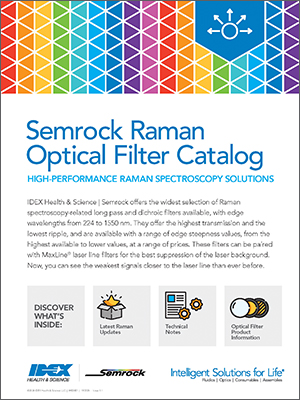 |
| Essential Performance Optical Filter Catalog | High Performance Optical Filter Catalog | Raman Optical Filter Catalog |
When system requirements push beyond standard offerings — such as unusual spectral constraints, unconventional form factors, or performance tradeoffs that don’t align cleanly within a single filter family — custom optical filters may be the most effective solution.
Examples and guidance can be drawn from our Finding Your Optical Filters Guide.
Speak with a Semrock Optical Filter Expert Request Custom Filter Solutions
 Optical filters are used in numerous applications, such as fluorescence microscopy, flow cytometry, point-of-care diagnostics, Raman Spectroscopy, and Optical Coherence Tomography. This guide explores the cost drivers of implementing a custom filter into an instrument to debunk the myth that custom must mean costly.
Speak with a Semrock Optical Filter Expert Optical Filter FAQs