
Stories & Features

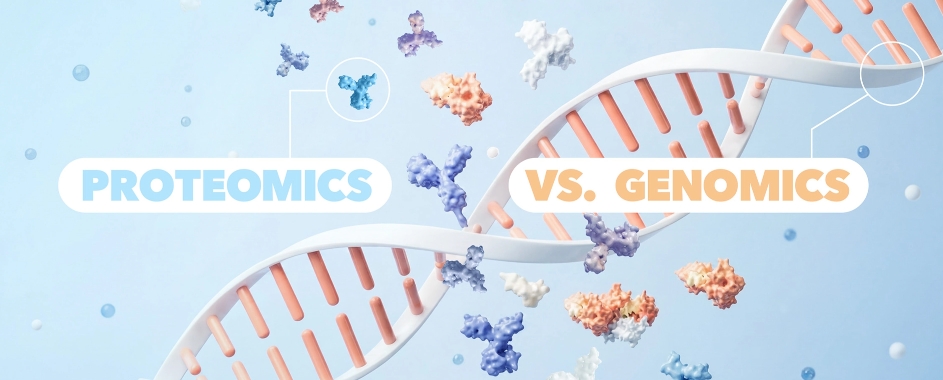
A practical breakdown of how these two sciences work, where they differ, and why both matter to drug discovery and diagnostics.
Proteomics is the study of all the proteins produced by a cell or organism. Genomics is the study of the complete set of DNA, including all genes. Genomics reveals what a cell could do, while proteomics reveals what it is doing. Together, they give researchers a fuller view of how diseases develop and how to treat them. Below, we break down each science, where they differ, and where they intersect in life science instrument development.
Proteomics is the systematic, large-scale analysis of proteins, based on the concept of the proteome: the complete set of proteins produced by an organism or cell at a given time. Because proteins drive cellular function and shift with conditions, proteomics offers a real-time view of biological activity that genomics alone cannot capture.
Proteins are essential to how cells function, which makes them central to life science research:
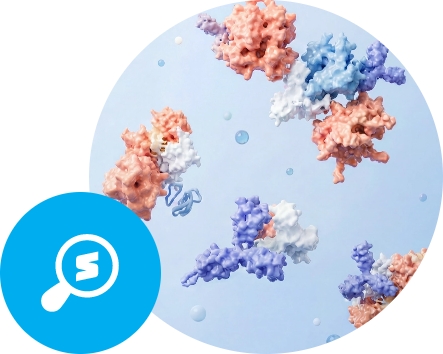
Because protein activity reflects what a cell is doing in the moment, proteomics gives researchers a direct view into disease mechanisms, treatment response, and biological state. Demand for proteomics instrumentation continues to grow as pharma, biotech, and clinical labs invest in protein-based research, with the global market projected to more than double between 2024 and 2030 [BCC Research, 2025].
Watch this introduction to proteomics to learn more about what it is, why proteins are central to disease research, and how proteomic analysis supports drug development, biomarker discovery, and life science innovation. Runtime: 2:35.
Build Your Proteomics Instrument View All Proteomics Videos
Genomics is the methodical, large-scale study of DNA, based on the concept of the genome: the complete set of genetic instructions found in a cell or organism. The genome remains essentially constant within an organism, providing a stable blueprint that genomics uses to map genes, identify variants, and trace hereditary disease.
The genome serves as the cell’s master instruction set, which makes genomics central to understanding disease:
Because the genome encodes the instructions cells use to build everything else, genomics gives researchers a foundational view of disease origins, hereditary risk, and therapeutic targets. Demand for sequencing instrumentation continues to grow as research, clinical, and pharmaceutical labs invest in DNA-based analysis, with the global DNA sequencing market projected to nearly double between 2024 and 2029 [BCC Research, 2025].
Next-generation sequencing has become the dominant technology in genomics research, and instrument performance depends on precise fluidic control. Learn how IDEX Health & Science fluidic components support sequencing reliability, uptime, and reproducibility.
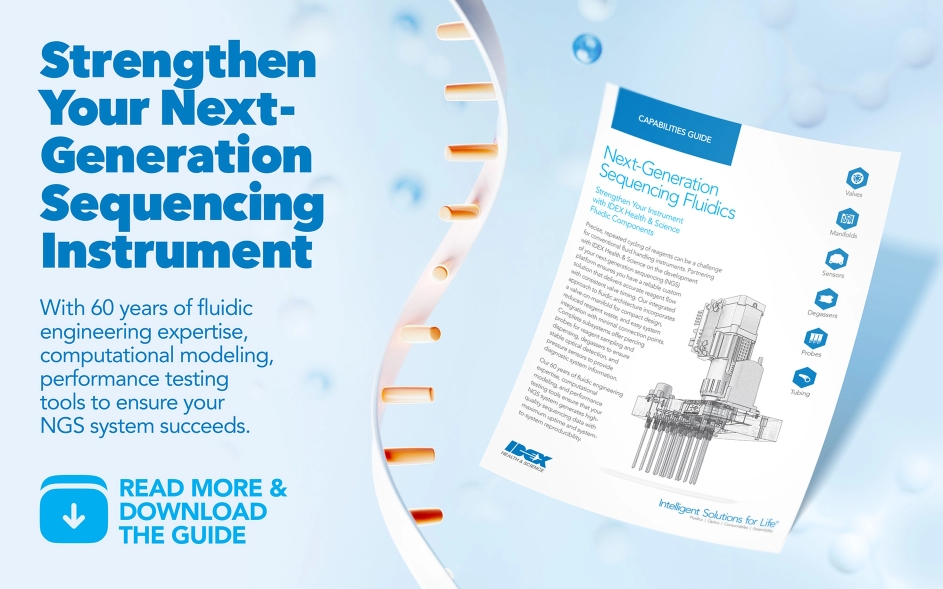
Explore Next Generation Sequencing Capabilities
While genomics and proteomics are complementary sciences, they differ in what they study, how they study it, and what each reveals. Genomics has been instrumental in linking disease to genes, while proteomics extends that understanding to the protein level. The table below shows how they compare.
Proteomics | Genomics | |
| What it studies | The complete set of proteins produced by a cell or organism (the proteome), including 3D structure, function, expression, and protein-to-protein interactions | The complete set of DNA, including all genes (the genome), and the sequencing, analysis, and mapping of those genes |
| What it reveals | What a cell is actively doing right now | What a cell is capable of doing |
| Subdisciplines | Expression proteomics, structural proteomics, and functional proteomics | Structural genomics and functional genomics |
| Stability over time | Changes constantly based on cell type, condition, and time | Remains essentially constant across cells in an organism |
| Estimated scale (human) | Estimated to exceed 1 million distinct protein forms, due to splicing and post-translational modifications | 20,000 to 25,000 protein-coding genes |
| Primary technologies | Mass spectrometry, liquid chromatography, immunoassays | DNA sequencing (including next-generation sequencing), microarrays |
| Common applications | Drug discovery, biomarker identification, clinical diagnostics, protein-based research | Disease-gene mapping, hereditary risk assessment, sequencing-based diagnostics |
Proteomics is more technically demanding than genomics because proteins themselves are harder to work with. Three factors drive that complexity: their sheer number, their three-dimensional structure, and the difficulty of preserving them through analysis.
The human genome contains roughly 20,000 to 25,000 protein-coding genes, but those genes can produce more than 1 million distinct protein forms through splicing and post-translational modifications. Where genomics analyzes a stable set of 20,000+ targets, proteomics must identify, separate, and quantify a much larger and more variable population, which is why high-resolution separation and detection technologies like mass spectrometry and liquid chromatography are central to proteomics instrumentation.

Unlike DNA’s relatively uniform double helix, every protein has a specific 3D structure that controls its function. That structure can be altered by post-translational modifications, environmental conditions, or interactions with other proteins, which is why proteomics instruments rely on high-precision fluorescence-based optical detection and carefully controlled sample handling to study protein behavior without disrupting it.

Proteins are sensitive to temperature, pH, and handling, and they can degrade, denature, or change form during sample preparation. Identifying a specific protein in a complex biological sample has been compared to finding a needle in a haystack, which is why proteomics instruments depend on precision fluidic control, stable temperature management, and consistent sample integrity throughout the workflow.
The complexity of proteomics is also what makes it so valuable for the most demanding life science applications, from drug discovery to clinical diagnostics.
 Get Expert Guidance on Proteomics Instrument Development
Proteomics supports four major application areas across modern life sciences: drug discovery, biomarker identification, clinical diagnostics, and applied proteomics. Each leverages protein-level insights to address challenges that genomics alone cannot fully solve.

Most modern drugs work by targeting proteins. Proteomics helps researchers understand how potential drugs interact with proteins in the body, identify new therapeutic targets, and design more effective treatments for diseases like cancer, cardiovascular disease, and infectious disease. Drug discovery is the largest application area in the global proteomics market.

Proteomics identifies proteins that signal disease presence, progression, or response to treatment. These biomarkers enable earlier diagnosis, more accurate prognosis, and better monitoring of how patients respond to therapy. Biomarker discovery is a rapidly growing application area in cancer research, neurology, and immune-driven disease.

Protein-based diagnostic tests translate research findings into clinical decision-making, from cancer detection panels to immune system monitoring. Clinical diagnostics is one of the fastest-growing segments in proteomics, driven by demand for personalized medicine and earlier disease detection.

Proteomics extends into applications beyond clinical medicine, including food safety, agricultural research, and characterization of biological systems for industrial uses. These applications use the same core proteomic techniques to solve problems in product safety, quality control, and biological process design.
Across all four application areas, proteomics workflows depend on instruments engineered for precision, repeatability, and sample integrity.
IDEX Health & Science is a leading partner in optics and fluidics technology and subsystems for life science and healthcare applications. We helped advance enabling technologies for genomic research and next-generation sequencing, supporting improvements in research and patient care worldwide. We are ready to bring that same engineering depth to your proteomics instrument development.
Our integrated approach spans fluidics, illumination, imaging, and optical filtering, and draws on decades of experience solving complex challenges. For companies and OEMs transitioning from next-generation sequencing to protein detection, we can help you develop instruments for liquid chromatography, mass spectrometry, and optical applications.

Mass Spectrometry

Liquid Chromatography
Immunoassay

Fluorescence Detection

Diagnostic

Liquid Biopsy
Explore the Full Range of Fluidics Applications We Support
IDEX Health & Science combines optical and fluidic capabilities into integrated solutions for proteomics instrument development:
Tell Us About Your Proteomics Instrument Program And An Applications Specialist Will Follow Up
OEM teams developing proteomics instruments face decisions around components, integration, and partner selection. Below are answers to common questions about developing proteomics instruments with IDEX Health & Science.
Risk reduction in proteomics instrument development typically comes from three sources: working with experienced component partners who have solved similar challenges before, validating designs through computational modeling and performance testing before committing to builds, and using a structured development process that catches issues early. A strong partner brings expertise across fluidic and optical engineering, plus the manufacturing experience needed to translate prototypes into reliable, repeatable production instruments.
Proteomics workflows place demanding requirements on instrument performance. Custom-engineered components let OEM developers optimize fluidic flow, optical detection, and sample handling for their specific application rather than working around the limitations of standard parts. The result is better instrument performance, faster development cycles, and tighter alignment between component capability and instrument requirements. Learn more
Proteomics instruments must deliver accuracy, reliability, and reproducibility across long operating cycles. Key engineering priorities include precision fluidic control to maintain consistent reagent flow, stable performance for maximum uptime, careful sample handling to preserve protein integrity, system-to-system reproducibility across production units, and integration of optical and fluidic subsystems into a compact, dependable platform.
Proteomics instrument development typically follows a structured process across several phases. IDEX Health & Science partners with OEM teams through five stages: a business phase to assess technical needs and develop a project case, a feasibility phase to evaluate the design approach, a design phase to iterate through development rounds and validate performance, a pre-production phase to complete testing and verification, and a market launch phase that includes life-of-instrument support. Learn more
IDEX Health & Science brings four core advantages to OEM proteomics instrument development. We help increase system reliability through proven fluidic and optical engineering. We reduce development time by drawing on existing component knowledge to advance your design quickly. We deliver consistency through tightly controlled quality and reproducibility. And, we improve the end-user experience by minimizing system failures and simplifying instrument use. Learn more
Yes. IDEX Health & Science supports OEM proteomics instrument development across the full lifecycle, from early concept and feasibility through design, pre-production testing, and market launch. This includes custom fluidic and optical component engineering, integration into complete subsystems, and life-of-instrument support after the product reaches market.
Tell us about your proteomics instrument project and what you’re trying to solve. An applications specialist will follow up to discuss how we can help.
*Required Field
Upon submission of this form, you will receive an email from IHSmarketing@idex-hs.com to verify your email address. Please open the email with subject line: "Please confirm your email address" and click "I confirm" to complete the request.

Watch our educational video series covering proteomics fundamentals, instrument applications, and IDEX Health & Science engineering expertise.

Proteomics Instrument Capabilities
Partner with our engineers to develop proteomics instruments for liquid chromatography, mass spectrometry, and detection applications.

Fluorescence Multiplexing Filter Guide
Learn how to select the right optical filters for fluorescence multiplexing in proteomics, imaging, and multi-channel detection applications.
Forbes Insights Supplier Study
Fve key insights from 180 senior life science executives on managing suppliers as strategic partners and unlocking supply chain innovation.