
Stories & Features

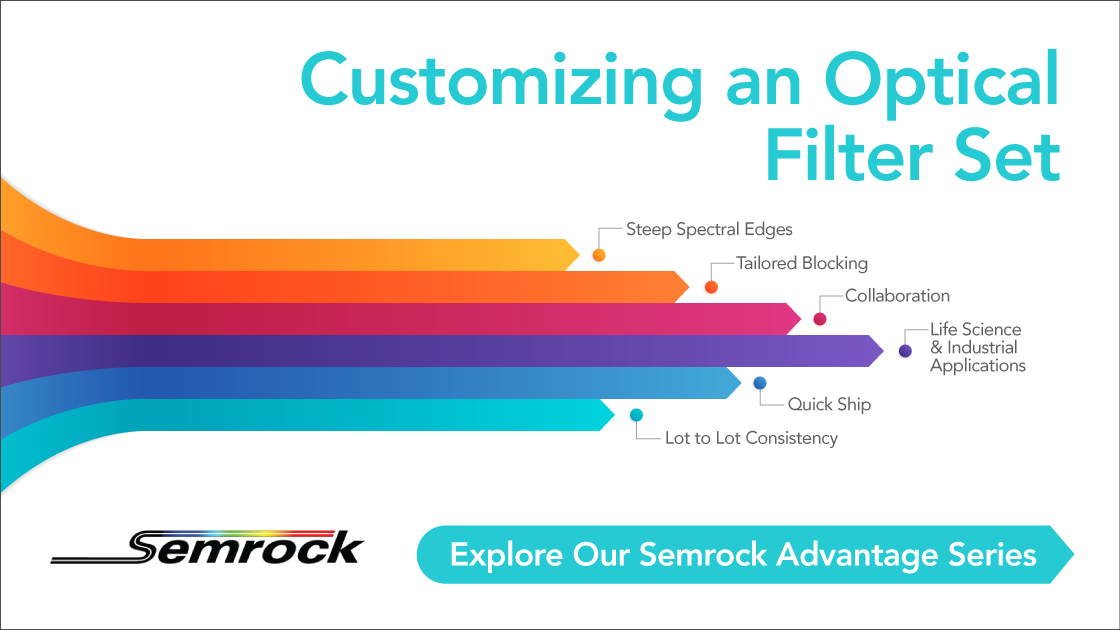
Each modern Semrock filter family is engineered around a distinct design philosophy. Within a given family, excitation, emission, and dichroic filters are designed to work together as an integrated system, balancing transmission, blocking, and edge steepness to meet the specific performance goals of that product line.
Although it is possible to combine filters from different families, doing so may require trade-offs because each family is optimized with its own design assumptions and priorities. Depending on the application, mixed-family configurations can deliver acceptable results, or may benefit from additional evaluation to ensure optimal performance.
Previous custom mix-and-match approaches were more straightforward because many Semrock filters shared similar underlying design priorities. Newer product families, however, incorporate more specialized coating architectures and application driven optimizations. For example, Avant™ filters are tailored for demanding applications involving fluorophores with short Stokes shifts, requiring extremely steep edges and minimal crosstalk. BrightLine® 2.0 filters emphasize exceptional signal-to-noise performance and broad versatility, while BrightLine Basic™ focuses on delivering strong performance value for routine imaging.
When filters from different families are combined, these differing design approaches can influence overall system behavior, including excitation efficiency, blocking effectiveness, and image contrast. In some cases, performance may align with the expectations of the highest-performing component; in others, the overall result may be limited by the more performance-value-oriented elements in the set. For instance, pairing a high-performance Avant filter with BrightLine Basic components may yield results consistent with BrightLine Basic-level performance, while incorporating the cost of the premium filter. Understanding these interactions helps ensure the right balance of performance and value for your application.
Selecting all filters from the same family remains the most straightforward way to ensure the system performs as intended, delivering the signal quality, spectral separation, and imaging reliability each product line is designed to provide. At the same time, cross-family combinations can be a practical and effective approach, particularly during early-stage development.
For OEM customers, mixing filters across families paired with accurate system modeling can be an efficient way to rapidly prototype and evaluate system performance before transitioning to a fully optimized or custom-designed filter set for volume production. This flexibility allows teams to explore design tradeoffs quickly while maintaining a clear path toward final system optimization.
Legacy compatibility remains flexible. For example, legacy BrightLine filters can be paired with BrightLine 2.0 filters, and legacy BrightLine Basic filters can be combined with current BrightLine Basic designs, typically with only minor performance differences.
To support these decisions, Semrock offers both analytical tools and expert guidance. The SearchLight™ tool, available on our website, empowers users to interactively analyze specific fluorophores and filter combinations, helping visualize spectral performance and potential tradeoffs. In parallel, our Applications Scientists work directly with OEM customers to understand system requirements and recommend optimized solutions tailored to the application.
In summary: selecting filters within a single filter family provides simplicity and confidence, while cross-family combinations can be a valuable and effective option when approached thoughtfully, with the support of the right tools and expertise.
Note About Vendor Mixing: In a high-performance optical system, filters don’t work in isolation—they work as a part of a team. If your excitation and emission filters aren’t compatible, your signal will be drowned out by noise. One of the most common mistakes we see is vendor mixing: buying a Semrock optical filter from IDEX Health & Science for its reputation and then sourcing the partner filter from a lower-cost vendor to save on the bottom line. Individually, both might pass inspection, but you’re risking optimal performance in your system. Learn more about vendor mixing here.