
Choosing Dichroic Beamsplitters with Flatness/RWE Appropriate to the Microscopy Method


Introduction
Wavefront distortion can degrade image quality by reducing contrast and/or compromising resolution. In a number of microscopy applications, wavefront distortion must not exceed specific values in order for the microscopy method to succeed.
A wavefront is the surface that connects all points of the propagating light wave that have the same phase, and which moves perpendicularly to the direction of light propagation. In a perfectly collimated beam, the wavefront is a plane. For a point source, the wavefront is a spherical surface. Deviations in the wavefront occur when light refracts through a medium with an inhomogeneous refractive index, or reflects off (or refracts through) a non-planar surface. This deviation is termed wavefront error and is specified by waves (λ) over distance across the surface of the optical element in question. The “waves” refer to multiples (or fractions) of the reference wavelength of 632.8 nm or 546.07 nm, depending on the optical standards being used.
IDEX Health & Science uses a number of high-precision metrology tools to measure wavefront deviations due to an optical component such as a mirror or filter, and the results are converted into values at the relevant reference wavelength for the customer.
TWE, Wedge, and RWE
Transmitted wavefront error (TWE) refers to deviations due for example to non-parallel surfaces of a filter (known as “wedge”), irregularities in the refractive index, and/or small-scale roughness of the glass. Measured and reported TWE usually do not include effects due to wedge, as wedge results in a “tilt” of the beam, which is removed from the calculation as it is not considered a distortion of the wavefront.
Semrock catalog filters from IDEX Health & Science tend to have low levels of TWE, due to the use of high-quality glass substrates that meet reasonably demanding TWE specifications, and the coatings usually do not introduce significant TWE. Custom filters can be accommodated with more demanding levels of TWE.
In filter cubes commonly used for fluorescence microscopy, small amounts of wedge in the dichroic and emission filters can lead to a measurable pixel shift between images acquired with different cubes. This effect can be eliminated through the use of Semrock ZERO pixel shift filter cubes that mitigate this shift for scientific grade digital cameras.
Non-trivial levels of Reflected Wavefront Error (RWE) can impede microscopy techniques in which a high quality reflected beam (i.e., one with low levels of aberration) is crucial for good performance. RWE is strongly influenced by the flatness of a dichroic mirror, as described below. Flatness and RWE are related by the following equation, where θ is the angle of incidence (AOI), which is 45° in Figure 1.
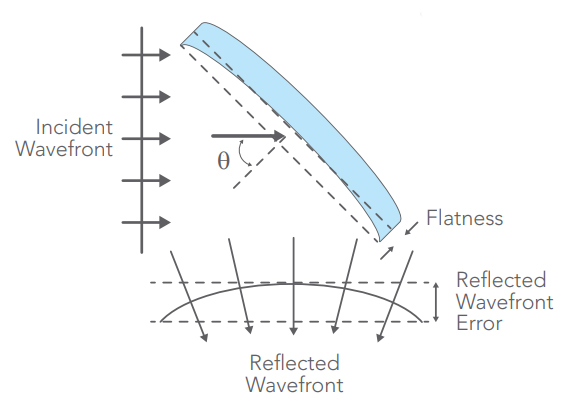
Figure 1: Relation between flatness and Reflected Wavefront Error
RWE = 2 × flatness × cos(θ)
Flatness deviations or RWE can arise from stresses in the filter coating that deform the substrate (glass) surface away from a purely planar state. This deformation can result in a spherical surface that is often described with a radius of curvature (ROC) specification, for example in meters. A larger ROC corresponds to a flatter optic (Figure 3b, c). RWE is a more complete specification because it includes the spherical component as well as higher order aberrations that more completely describe the wavefront. A customer may alternatively specify either RWE or flatness over a specified diameter of an area in terms of fractions or multiples of the wavelength of light at the reference wavelength.
An example specification may be written “RWE < 0.5 waves PV over 10 mm @ 45° @ 632.8 nm,” meaning that the measurement is made over an area with a diameter of 10 mm using light incident at AOI = 45°, and is referred to units of the wavelength 632.8 nm. Typical area values include the clear aperture of the filter, one inch, and the beam size. Reference the table in the “What is flatness / RWE classification?” FAQ to find the Semrock optical filters best suited to the application and maximum beam diameters.
Deviations from flatness have two effects on RWE at angles greater than zero: (1) the focal plane can shift position, and (2) the beam can acquire optical aberrations (e.g., astigmatism). For an in-depth discussion of these effects, see the resource Flatness of Dichroic Beamsplitters Affects Focus and Image Quality. While a focal plane shift can sometimes be corrected by lenses in the beam path, optical aberrations such as astigmatism can irreversibly degrade image quality (Figure 3b,c).
Microscopy Methods and Appropriate RWE or Flatness
Fluorescence microscopy methods that use a single-element detector (e.g., photodiode or PMT) or multiple-pixel-based detection systems (cameras) largely fall into four cases depending on whether an image is required at the sample plane, at the detection plane, or at both. These properties dictate the RWE specs required for dichroic filters in the system in order to achieve good performance. For more details on the effect of wavefront deviations on these methods, please see the white paper, Maximizing the Performance of Advanced Microscopes by Controlling Wavefront Error using Optical Filters.
Case 1
The entire field of view is illuminated simultaneously and the signal is captured with a camera (Figure 2). Even illumination of the field of view (FOV) is achieved by focusing the image of the light source on the back aperture of the objective. The RWE of the dichroic mirror does not affect the quality of the image, because the reflected light is only used for excitation. The emission image passes through the dichroic and is therefore not affected by the RWE.
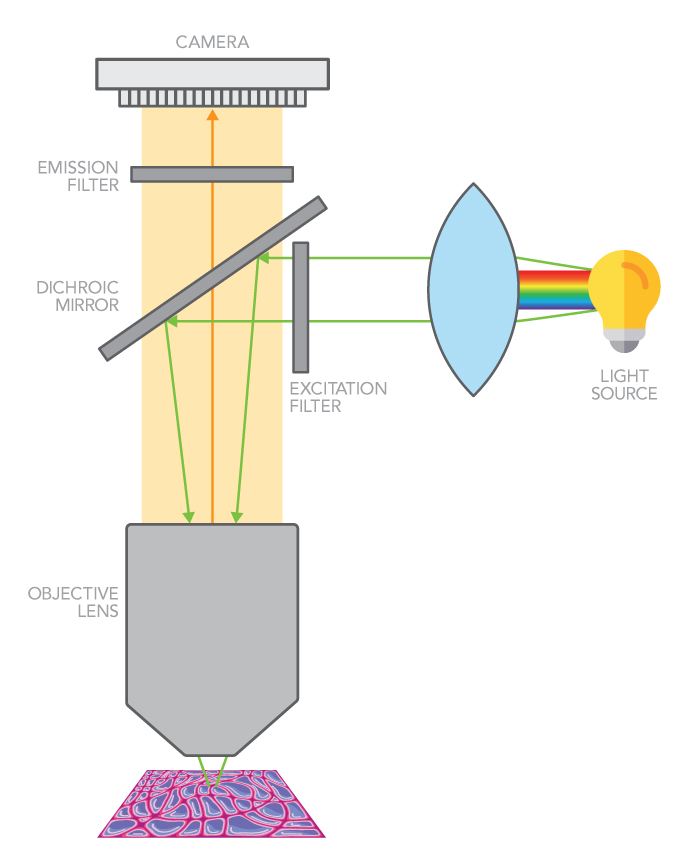
Figure 2: For widefield illumination, the excitation light is focused onto the back aperture of the lens to illuminate the entire FOV. Emitted light passes through the dichroic and emission filters to reach the camera.
Case 2
The entire field of view is illuminated, as in Case 1, but two or more detection cameras are used simultaneously with dichroic beamsplitters between them (Figure 3a). The dichroic beamsplitter that reflects the emission beam to the camera on the left will degrade the image if its RWE were significant. A more demanding RWE specification (e.g., with larger ROC) is required in the detection path to maintain image fidelity across detectors. As shown in Figures 3b and 3c, a larger ROC (flatter dichroic) yields a clearer image.
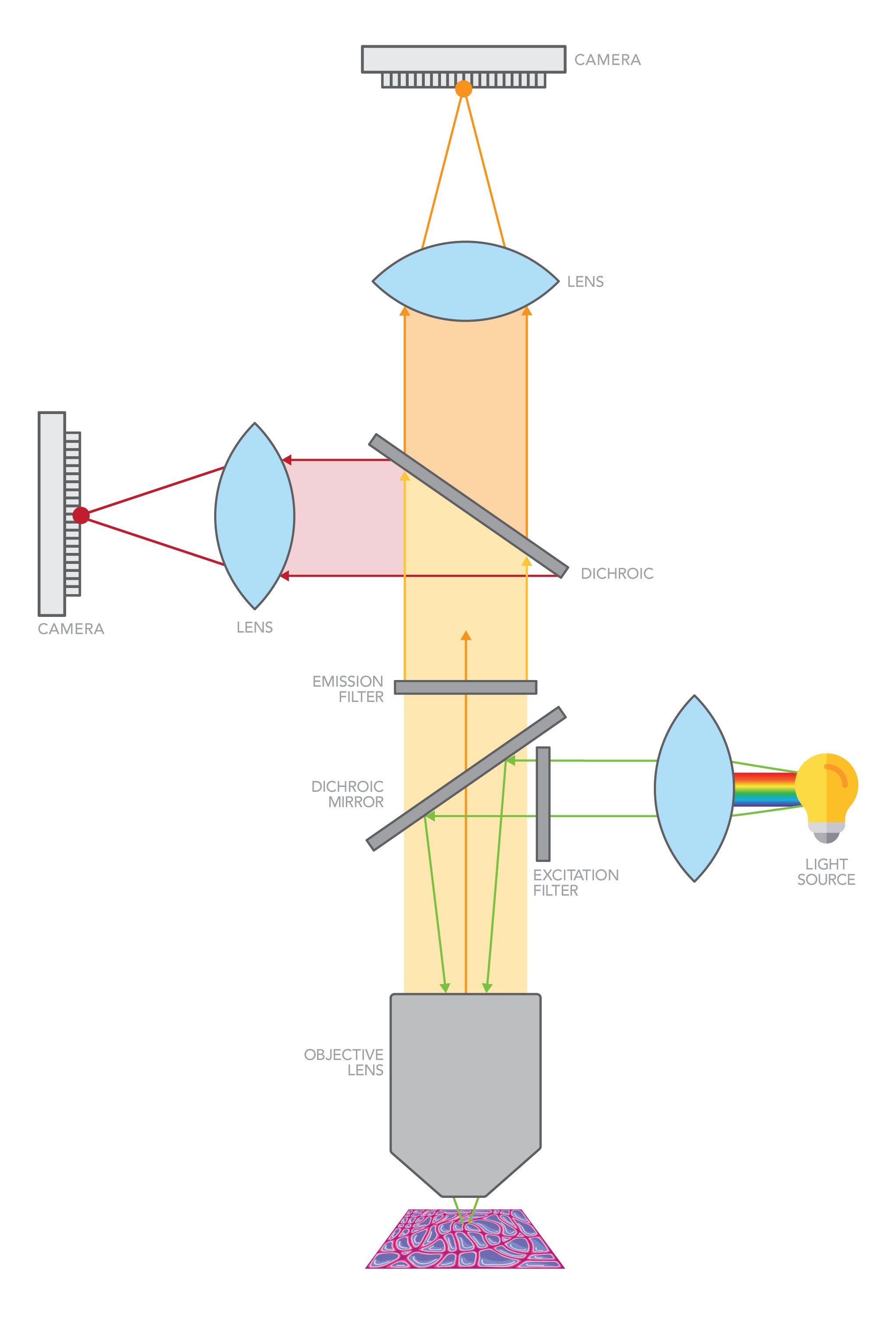
Figure 3. (a) The detection path is split between two or more cameras using a dichroic mirror.
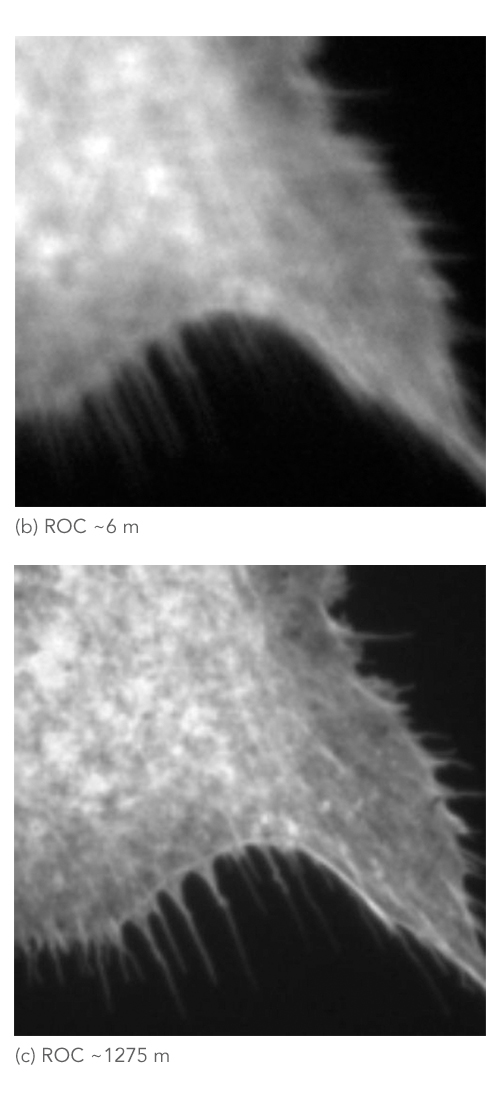
Figure 3. (b,c) Image output of the left-hand (reflected) detector with two different radii of curvature (ROC). [Images of F-actin in bovine pulmonary artery endothelial cells (FluoCells® Prepared Slide #1, ThermoFisher Scientific, Waltham, MA, USA) as imaged on a BX41 microscope (Olympus Corporation of the Americas, Center Valley, PA, USA) with a 40×, 0.75 NA objective and Retiga camera (QImaging, Surrey, BC, Canada)].
Case 3
A laser beam is focused on the sample to provide excitation at a single point, and detection uses a single-element detector (Figure 4). The beam is scanned across the sample in these methods, as is the case with scanning confocal, multiphoton, Raman, and STED. The dichroic mirror that reflects the beam towards the confocal pinhole must have very good RWE to avoid distorting the emission beam and therefore the emission image. Multiphoton microscopy can also include several dichroic beamsplitters and single-element detectors, but demanding RWE specs are not always required for this case.
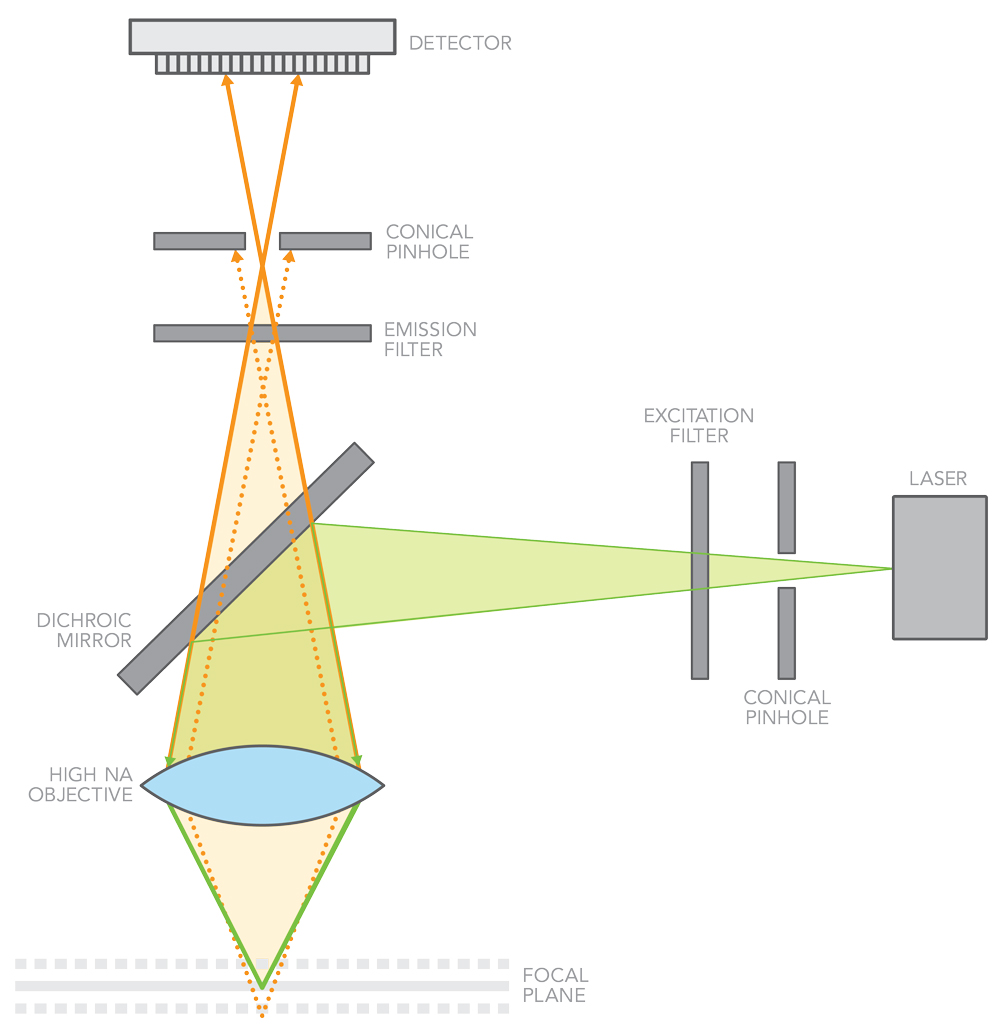
Figure 4. Confocal microscopy uses a scanning laser spot and pinholes with a single-element detector to isolate the signal from a single focal plane.
Case 4
A laser beam is used to illuminate the sample in a particular way and a camera is used in detection (Figure 5). Techniques that use this method include structured illumination microscopy (SIM), multipoint scanning methods (spinning-disk confocal and multiphoton), and TIRF microscopy. SIM projects an excitation pattern onto the sample, inducing interference, which is detected by the camera and interpreted using specialized software. TIRF microscopy transmits a laser beam through the edge of the input pupil of a high NA objective to illuminate the sample FOV using total internal reflection.
This case is often associated with super-resolution techniques such as STORM or PALM. Multipoint scanners use an expanded laser and a spinning disk of pinholes to scan across the sample and focus the resulting emission spots on a camera. These techniques all require good control of the wavefront of the excitation beam(s) and detection paths to achieve the best results. IDEX Health & Science has designed a number of products specific to TIRF and super-resolution methods.
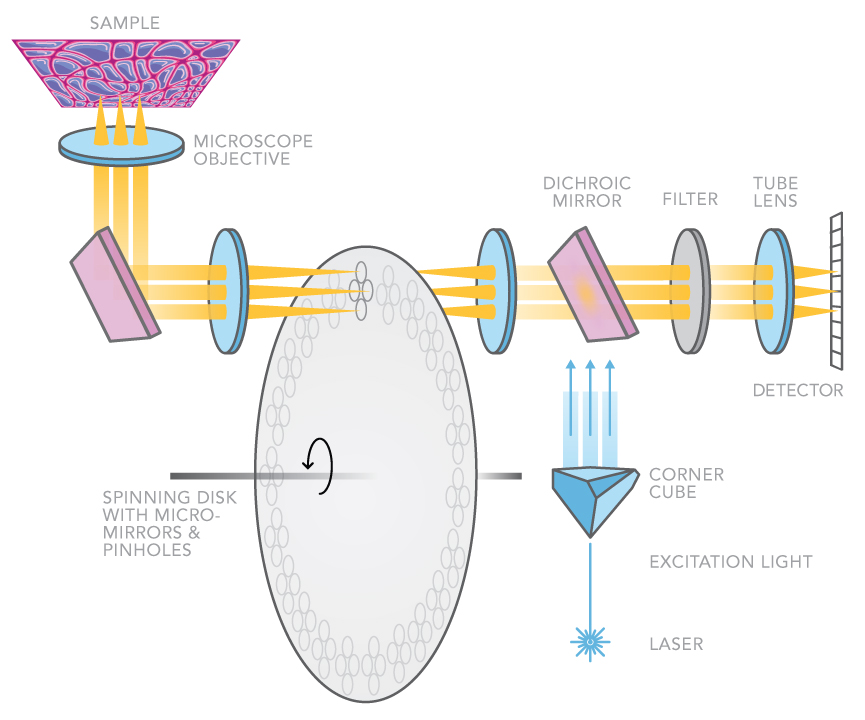
Figure 5. The spinning disk confocal uses an expanded laser beam to focus multiple spots onto the sample simultaneously. The emitted light is focused onto corresponding points of the camera surface.
For more specific information on these applications, and for a detailed discussion of beam diameter effects, please see the white paper on this topic, Maximizing the Performance of Advanced Microscopes by Controlling Wavefront Error using Optical Filters. Table 1 summarizes the techniques that require highly flat dichroic mirrors. As noted in this table, high flatness (low RWE) requirements can apply to reflective paths used in both illumination (excitation) and detection (emission).
Table 1: A list of popular microscopy methods, categorized as to criticality of dependence on RWE.
| Microscopy Technique | RWE Needed in a Reflected Excitation Beam | RWE Needed in a Reflected Emission Beam |
| Widefield Fluorescence Microscopy | Non-critical | Critical |
| Total Internal Reflection Fluorescence (TIRF) Microscopy | Critical | Critical |
| Stochastic Switching (PALM, STORM, etc.) | Critical | Critical |
| Stimulated Emission Depletion (STED) – Pulsed Microscopy | Critical | Non-critical |
| Confocal Single-point Scanning Microscopy | Critical | Non-critical |
| Combining Multiple Laser Beams | Critical | Not Applicable |
IDEX Health & Science offers an extensive and industry-leading range of Semrock brand catalog filters for a variety of applications with specific Flatness / RWE needs. The Flatness Classifications listed in the “ What is flatness / RWE classification?” FAQ provides an intuitive approach to selecting products of appropriate flatness for a given application.
Additional Resources
Want to explore other optical filter tech notes, white papers, or catalogs? | |
| Have a question? | Visit our FAQ section or connect with our team of optical filter experts. |