
Stories & Features

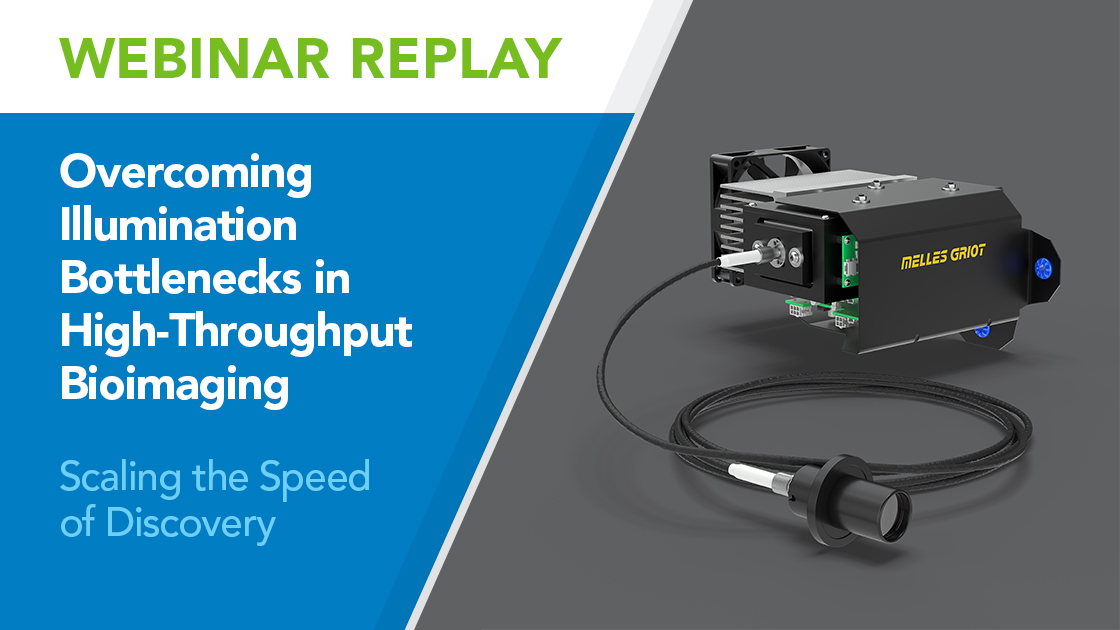
As imaging requirements evolve from basic research to high-volume clinical and drug discovery applications, the demand for high-throughput, high-resolution performance has never been greater. Whether in next-generation sequencing (NGS), next-generation proteomics, spatial biology, digital pathology, or high-content screening, the goal remains the same: Capture more data in less time. However, increasing system throughput typically requires larger fields of view or faster scanning speeds, both of which lead to "light starvation,” a scenario where the imaging sensor’s potential is limited by insufficient excitation irradiance.
This webinar explores the critical role of high-power laser engines in breaking these speed barriers, serving as a foundational technology for life sciences, diagnostic, and medical technology OEMs. Baggi Somasundaram will examine the two primary methods for achieving higher throughput: large-field "step-and-shoot" imaging and ultrafast line scanning with time delay integration (TDI) sensors. Both approaches present unique optical challenges, from maintaining uniform power density across large fields of view to compensating for the microsecond exposure times of high-speed scans. Finally, Somasundaram will demonstrate how Melles Griot High Power Laser Light Engines and advanced beam-shaping optics enable life sciences and medical technology OEMs to develop high-throughput, high-resolution fluorescence imaging platforms within accelerated timelines, ensuring precision and reliability.
The ideal audience for this webinar includes imaging and optical engineers, biotechnology R&D scientists, clinical assay developers, and system integrators. Imaging and optical engineers are professionals designing next-generation hardware for NGS, digital pathology, or spatial biology who need to solve excitation irradiance bottlenecks. Biotechnology R&D scientists include researchers in drug discovery and proteomics seeking to scale throughput without compromising data quality or resolution. Clinical assay developers are those transitioning benchtop assays into high-volume clinical diagnostics and high-content screening (HCS). System integrators are engineers building complex, multimodal imaging platforms that require high-speed scanning and large fields of view.
Our speaker Baggi Somasundaram, Ph.D., explores this topic in our latest webinar. Watch the replay below!
Baggi Somasundaram, Ph.D., is a senior product manager at IDEX Health & Science, Optical Systems, where he has served for the past eight years. He brings more than 30 years of experience in advanced microscopy and imaging solutions. Before transitioning to the life sciences industry, Somasundaram spent a decade in academic research as a cell biologist, exploring the role of ion channels in cell signaling pathways through electrophysiology and advanced imaging techniques. Throughout his industry career, he has held a wide range of roles spanning applications, technical sales, business development, product marketing, and product management. Somasundaram has successfully led to the launch of multiple life sciences imaging platforms, including live-cell confocal imaging systems, high content screening instruments, and digital pathology solutions.