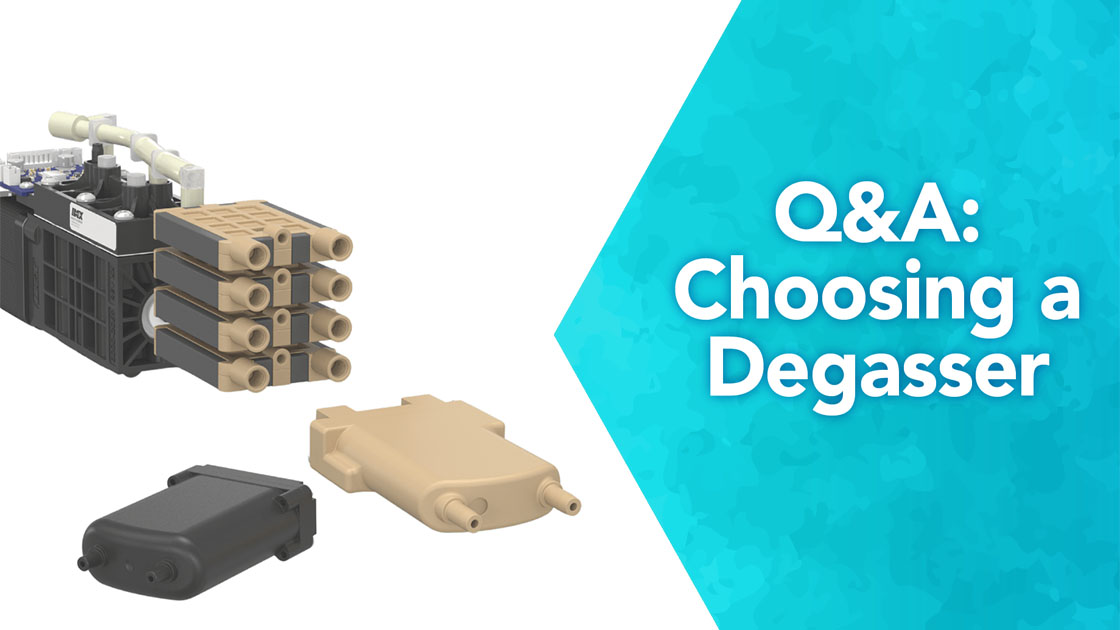
Summary: Choosing the right life science degasser starts with understanding your system’s unique parameters. These eight questions below help clarify key performance and compatibility factors so you can identify what’s
needed for optimal degassing in your application.
- Question: Why is there a minimum recommended flow rate for degassing chambers?
Answer: While it is true that the longer a liquid stays in the vacuum chamber, the more time
there is for gas to permeate through the membrane and be removed by the vacuum pump, running at too low a flow rate, especially at high vacuum pressure, can lead to “over-degassing.” This may cause solvent pervaporation (evaporation)
through the membrane and affect analytical accuracy.
- Question: What is degassing, and why is it important in fluidic systems?
Answer: Degassing is the process of removing dissolved gases from liquids. In fluidic systems, especially in life sciences, dissolved gases
can form bubbles that disrupt flow, cause baseline noise in detectors, and lead to inaccurate results. Degassing ensures consistent, bubble-free flow for reliable performance.
- Question: What are common sources of dissolved gases in fluidic systems?
Answer: Dissolved gases can enter fluids through exposure to air, temperature changes, pressure drops, or mixing. Even freshly prepared
solutions can contain gases like oxygen or nitrogen that need to be removed.
- Question: My system is very sensitive to metals. Is your flow path metal-free?
Answer: Our chambers offer a complete metal-free flow path for compatibility across a wide range of applications.
- Question: Which degassing chamber is best for my application?
Answer: Material selection will be the first critical step. If the fluids you are using are mainly aqueous, silicone, or Teflon™,
chambers can be selected. However, if your fluids contain organic solvents, only Teflon™ chambers should be chosen. The next consideration is the application flow rate. Ensure the chamber you select is the best size to maintain
efficient gas removal (residence time). We are happy to help you select the best option for your application needs.
- Question: Once my degasser is designed, what other considerations should I have for my system?
Answer: To prevent re-gassing of fluids, ensure the rest of the system is plumbed with non-permeable tubing. We offer a wide variety of PEEK, SST, and fluoropolymer tubing to help meet your system plumbing needs.
- Question: Where would I install the degasser in my flow path? Can I install it after the pumps?
Answer: For the longest lifetime operation, position degassing chambers before the pump pulls the fluid into your
system. They should not be placed inline after push set up; otherwise, there is a risk of pressure rupturing the membrane.
- Question: How complicated is it to integrate a degasser into my instrument design?
Answer: Our degassing systems come with PCBs for quick connectivity and access to our IDEX Health & Science Library--powered by Python™ for fast start-up and programming.
Once you’ve considered these factors, view our Degassing Solutions Guide to choose the right degasser, comparing available degassing solutions based on chamber material, flow rate, pressure tolerability, and compatibility. Partner with IDEX
Health & Science to minimize variability and boost instrument performance with custom degassing solutions tailored to your fluid design and application.
VIEW OUR DEGASSING SOLUTIONS GUIDE
PARTNER WITH US ON YOUR NEXT DEGASSING PROJECT