


Stories & Features
From concept development to scalable manufacturing, choosing the right reagent storage strategy can determine the success of your microfluidic device. Below are insights on our new reagent storage technology for point-of-care cartridges used in diagnostics—led by our expert Stefan Leidheiser, Senior Customer Project Manager at thinXXS. thinXXS develops and manufactures microfluidic consumables, cartridges, and reagent storage solutions for diagnostic and life science applications.
✅ Select microfluidic reagent storage concepts early in development
✅ Align storage strategy with final manufacturing requirements
✅ Consider scalability beyond proof-of-concept testing
✅ Use dry reagent solutions to maximize shelf life
✅ Leverage carrier-based technologies to improve quality control and production efficiency
✅ Design with both assay performance and commercialization in mind
Download the Reagent Storage & Handling Handbook
Point-of-care (POC) diagnostics have transformed how testing is performed, bringing laboratory-quality results closer to patients, clinicians, and field operators. The key to this convenience is simplicity: users should be able to run complex assays with minimal training and very few manual steps.
To make that possible, the reagents required for an assay must be stored directly on the microfluidic cartridge design. While often overlooked during early development, reagent storage plays a critical role in:
The wrong storage approach may work during proof-of-concept testing but can quickly become a bottleneck when transitioning to high-volume production. That’s why reagent storage should be considered from the earliest stages of microfluidic cartridge design.
Every successful microfluidic device begins with a clear understanding of the assay requirements. Key considerations include:
POC systems are designed for ease of use. Reducing user steps lowers the risk of errors and enables operation outside traditional laboratory environments.
This means:
A reagent storage solution must support:
Storage concepts must protect reagent functionality throughout:
The ideal solution should not only work in the lab—it should also be:
Most microfluidic development projects follow a phase-gate process:
A common mistake is selecting a storage solution that is easy to implement during feasibility testing but difficult to manufacture at scale.
The result?
A more effective strategy is to choose a scalable reagent storage concept from the start and maintain that approach throughout the entire product lifecycle.
By leveraging proven, standardized technologies early, development teams can significantly reduce risk and accelerate time-to-market.
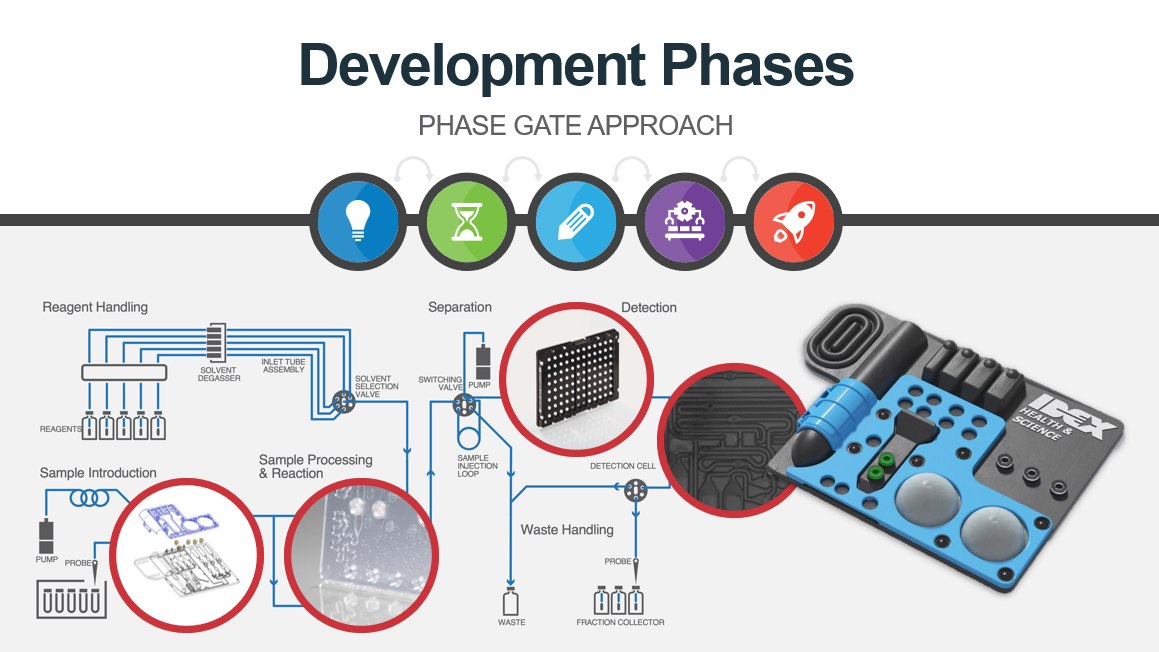
thinXXS development process: The reagent plug can be adapted to the specific situation, but the concept does not change from concept through feasibility to production. Existing standards and test-platforms can be used and loops can be avoided which reduces the associated costs in the development of a new card.
Liquid reagents remain essential in many diagnostic workflows, especially for buffers, wash solutions, and assay chemistries. Two primary storage approaches are commonly used include Blister Packs and Integrated Storage Tanks
Blister packs are among the most widely adopted solutions for storing liquid reagents on microfluidic cartridges.
A standard blister pack consists of:
During operation:
Benefits
Limitations
Traditional blister designs present several challenges:
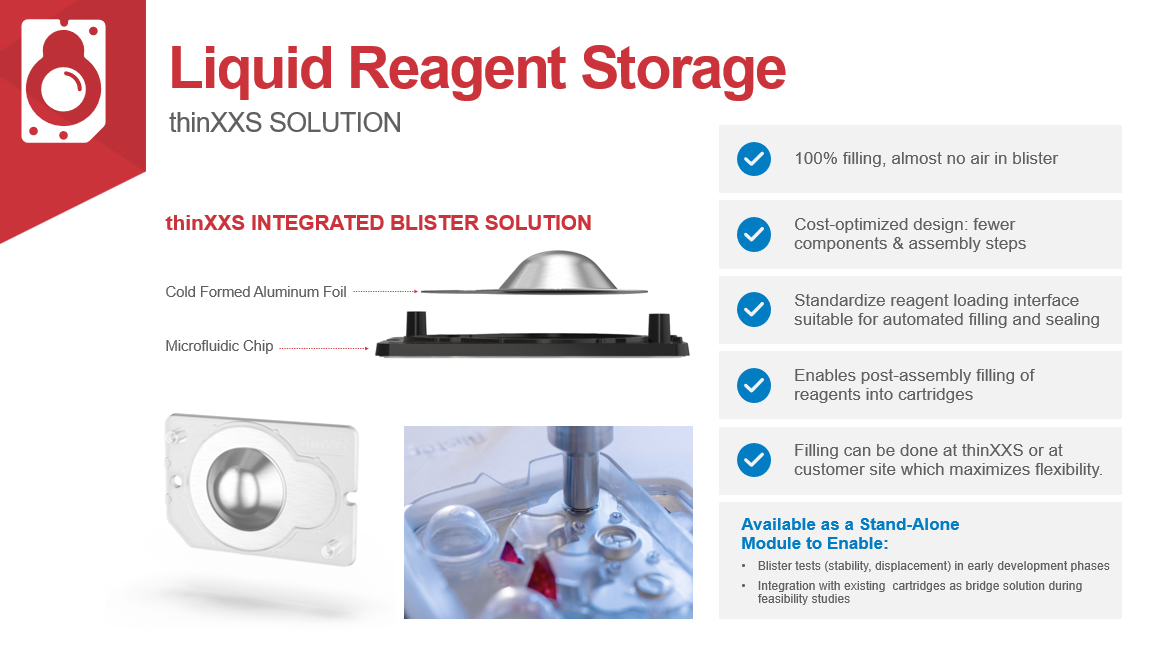
A more advanced approach integrates the blister directly onto the microfluidic chip.
Mechanical actuation opens a frangible seal, enabling controlled liquid release with stable flow characteristics.
Because the technology can also be implemented as a stand-alone module, it is particularly useful during:
When applications require very large or extremely small reagent volumes, integrated liquid tanks may be the preferred choice.
These reservoirs are molded directly into the cartridge backbone during injection molding.
Integrated tanks:
Liquid movement can be driven through:
The result is a fully enclosed reagent storage architecture that improves reliability while reducing system complexity.
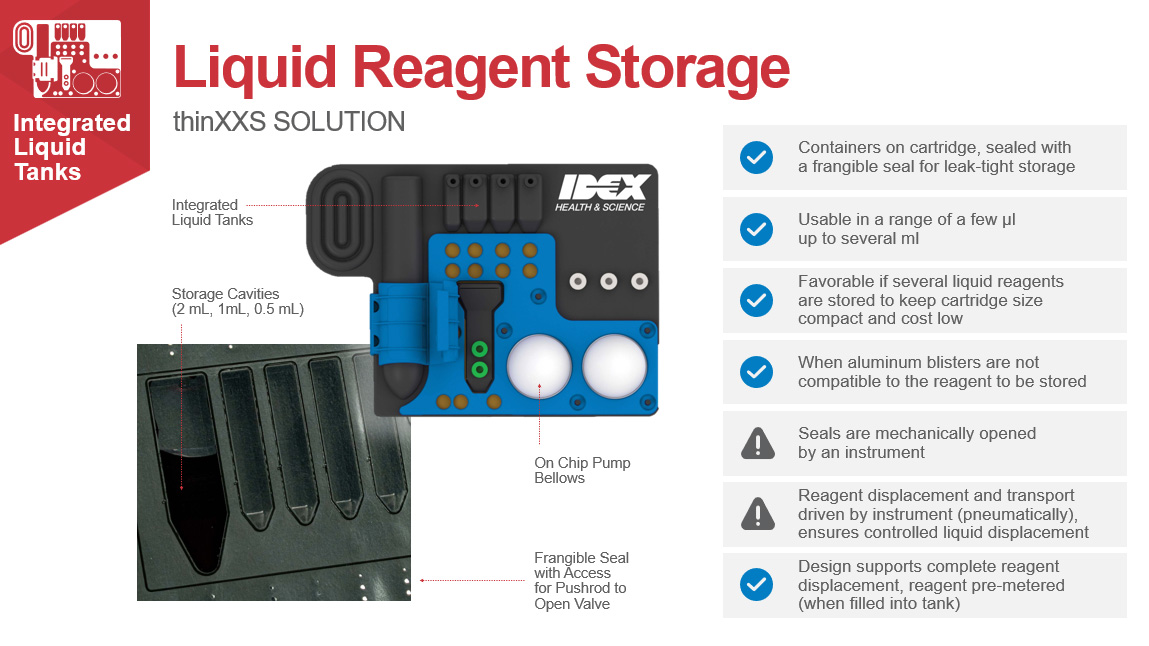
thinXXS liquid reagent storage technology uses significantly less materials and requires fewer process steps.
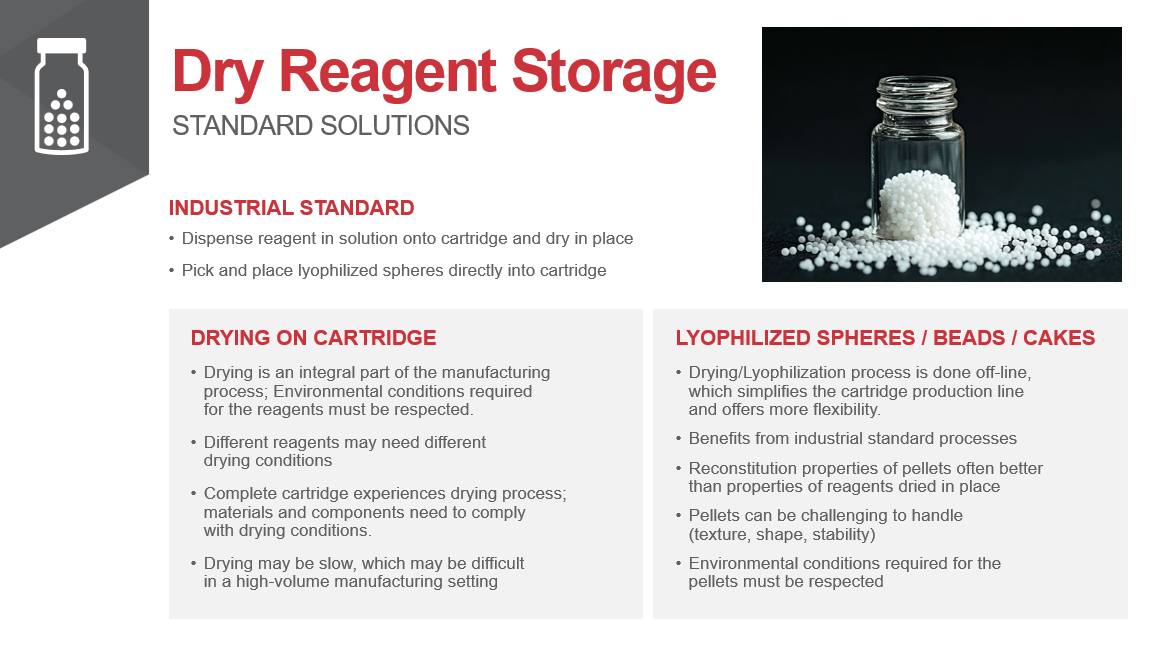
For many biological assays, particularly those involving sensitive biomolecules, dry reagent storage is essential.
Reagents are dispensed directly into cartridge chambers and subsequently dried.
Pre-formed pellets are inserted during cartridge assembly and reconstituted when needed.
While both solutions are widely used, scalability and reagent integration can become challenging during mass production.
One of the most promising advancements in reagent handling is the use of carrier-based reagent integration.
Rather than drying reagents directly inside the microfluidic cartridge, reagents are first immobilized onto a separate carrier component.
This decouples:
The result is greater flexibility and improved production efficiency.
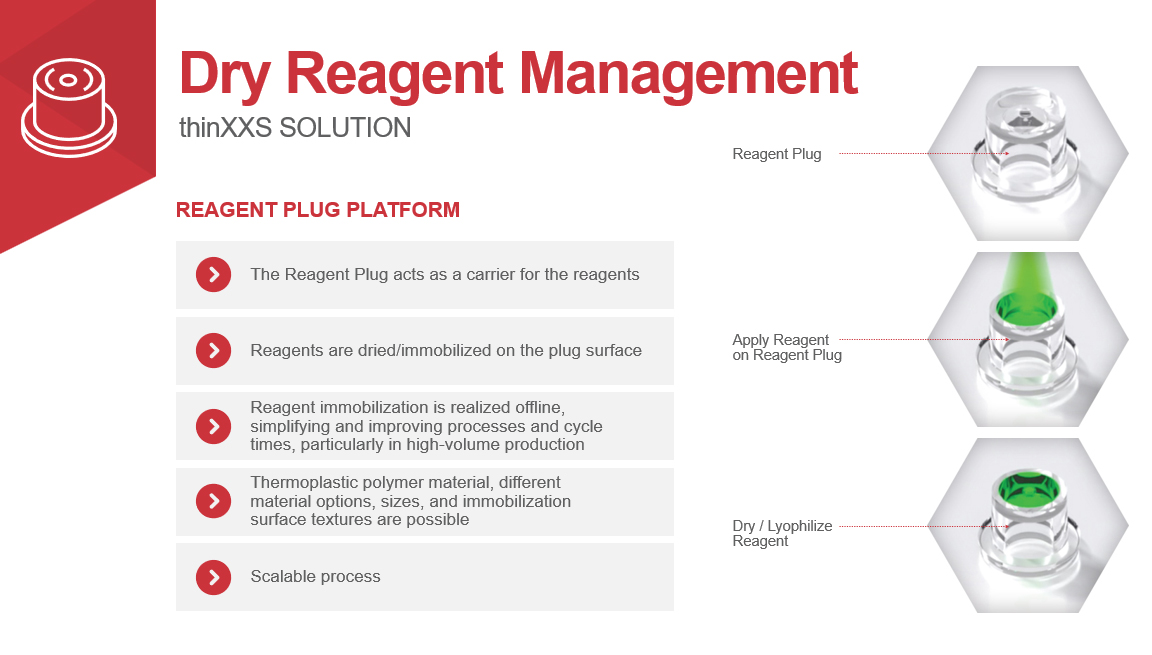 The Reagent Plug workflow from thinXXS addresses the challenges associated with efficient, high-throughput drying of reagents and the handling of the dried reagent pellets during manufacturing.
The reagent plug platform follows a highly scalable workflow.
Step 1: Independent Manufacturing
Reagent plugs are injection molded separately from the microfluidic cartridge.
Step 2: Reagent Loading
Reagent solutions are dispensed onto each plug's immobilization surface.
Step 3: Drying or Lyophilization
The loaded plugs undergo drying or freeze-drying.
Step 4: Automated Assembly
Robotic systems place the finished reagent plugs into designated cartridge locations.
Step 5: Final Integration
The plugs can be permanently sealed into the cartridge when required.
Why This Matters
Because reagent preparation occurs independently from cartridge production, manufacturers gain:
Reagent plug technology can also support lyophilized bead integration.
When fabricated from thermoplastic elastomers, the plug becomes an active functional element within the cartridge.
This enables:
The result is stronger assay performance while maintaining a highly scalable manufacturing process.
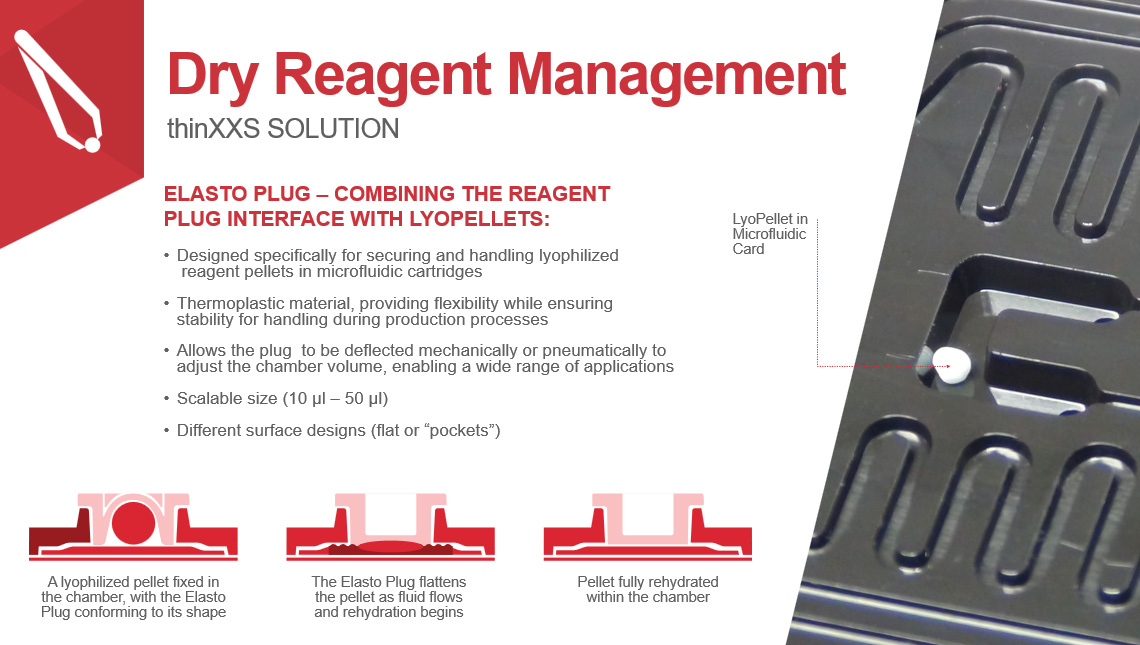
With the ThinXXS design, the lyoPellet is first loaded in the designated chamber on the card which is then closed with the reagent plug. The advantage is the plug can be deflected mechanically. This can be used to facilitate reconstitution of the reagent e.g. by crushing the pellet and by imposing a mixing action. After reconstitution, the plug can remain deflected which reduces the chamber dead volume.
| Storage Method | Best For | Advantages | Challenges |
|---|---|---|---|
| Blister Packs | Liquid reagents | Proven technology, flexible volumes | Additional assembly and sealing |
| Integrated Liquid Tanks | Very small or large volumes | Reduced component count | Requires cartridge integration |
| Reagent Plugs | Dry reagents | Scalability, quality control | Requires separate plug manufacturing |
Reagent storage is the method used to store liquid or dry assay reagents directly on a microfluidic cartridge so they can be released during testing without additional user handling.
Reagent storage impacts assay performance, shelf life, user experience, manufacturing scalability, and overall device reliability.
The most common approaches are blister packs and integrated liquid storage tanks built into the cartridge.
Reagent plugs are carrier-based components that allow reagents to be dried, stored, and integrated into cartridges separately from cartridge manufacturing, improving scalability and quality control.
The optimal solution depends on assay requirements, volume needs, stability requirements, and production scale, but storage concepts that support automated assembly and scalable manufacturing are generally preferred.

Stefan Leidheiser is a Senior Customer Project Manager at thinXXS
Stefan studied microsystems engineering. He joined thinXXS in 2010 with an initial focus on different microfluidic liquid reagent storage concepts. He has spent the last 14 years as an R&D Project Manager / Customer Project manager.