
Stories & Features

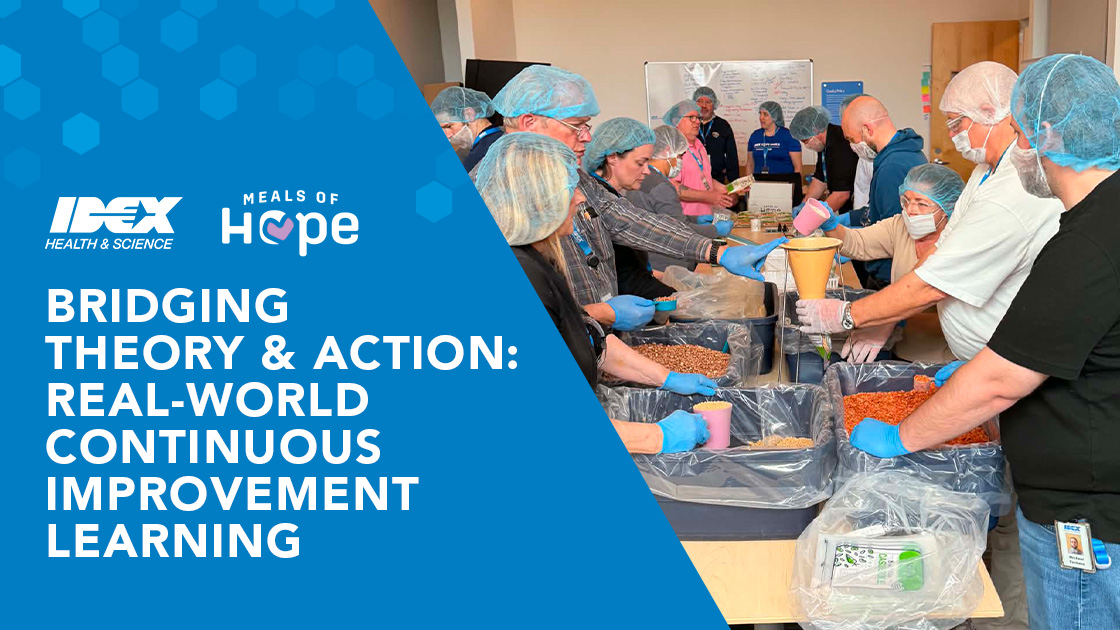
How 2 production lines, 62 volunteers, and continuous improvement principles packed nearly 15,000 meals for Rochester families.
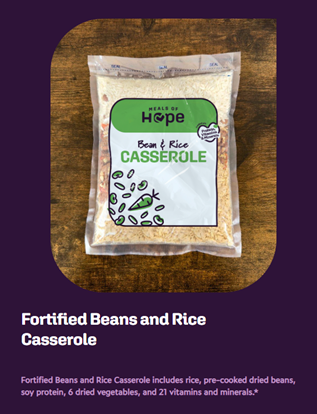
When we think about Continuous Improvement (CI) and Lean methodologies (a systematic business approach focused on maximizing customer value while minimizing waste and optimizing process efficiency), we often picture manufacturing floors, optimized supply chains, or streamlined software workflows. But recently, our IDEX Health & Science team in Rochester, NY designed a hands-on CI training event to sharpen our operational skills while simultaneously tackling the urgent crisis of local childhood food insecurity.
Partnering with Meals of Hope and backed by a generous $7,500 grant from the IDEX Foundation, we planned this live learning experience with a dual objective: challenge our volunteers to master and apply core CI principles in real time, while packaging 15,000 high-nutrition bean and rice meals destined for local families in need through Foodlink.
Before any tape was rolled or any scale calibrated, our team gathered to ground ourselves in the data driving this initiative. The reality in Monroe County and the broader Rochester region is sobering. Hunger is not a distant issue; it is actively intensifying right in our neighborhoods:
1 in 5Children (≈18–19%) in Monroe County face food insecurity, affecting roughly 29,000 local kids. | 42%Child poverty rate in the City of Rochester, driving regional family poverty to 3x surrounding areas. | +35%Increase in local food pantry visits in just one year, with regional requests hitting 1.86M in 2024. |
With food insecurity in the Rochester region climbing to 12.8%—the highest in a decade—families are being forced to make agonizing choices. Sixty-one percent of families earning under $100k report having to ration food between paychecks, and nearly half of low-income parents routinely skip meals entirely so that their children have something to eat. Faced with these metrics, our goal wasn't just a corporate target; it was an absolute necessity for our community.
True to our continuous improvement roots, we treated the meal-packing event as a formal manufacturing exercise. We received bulk food material, a pile of assorted tooling, and food safety PPE from Meals of Hope. From this raw state, our operational mandate was to construct a highly efficient, self-sustaining production system under strict boundaries:
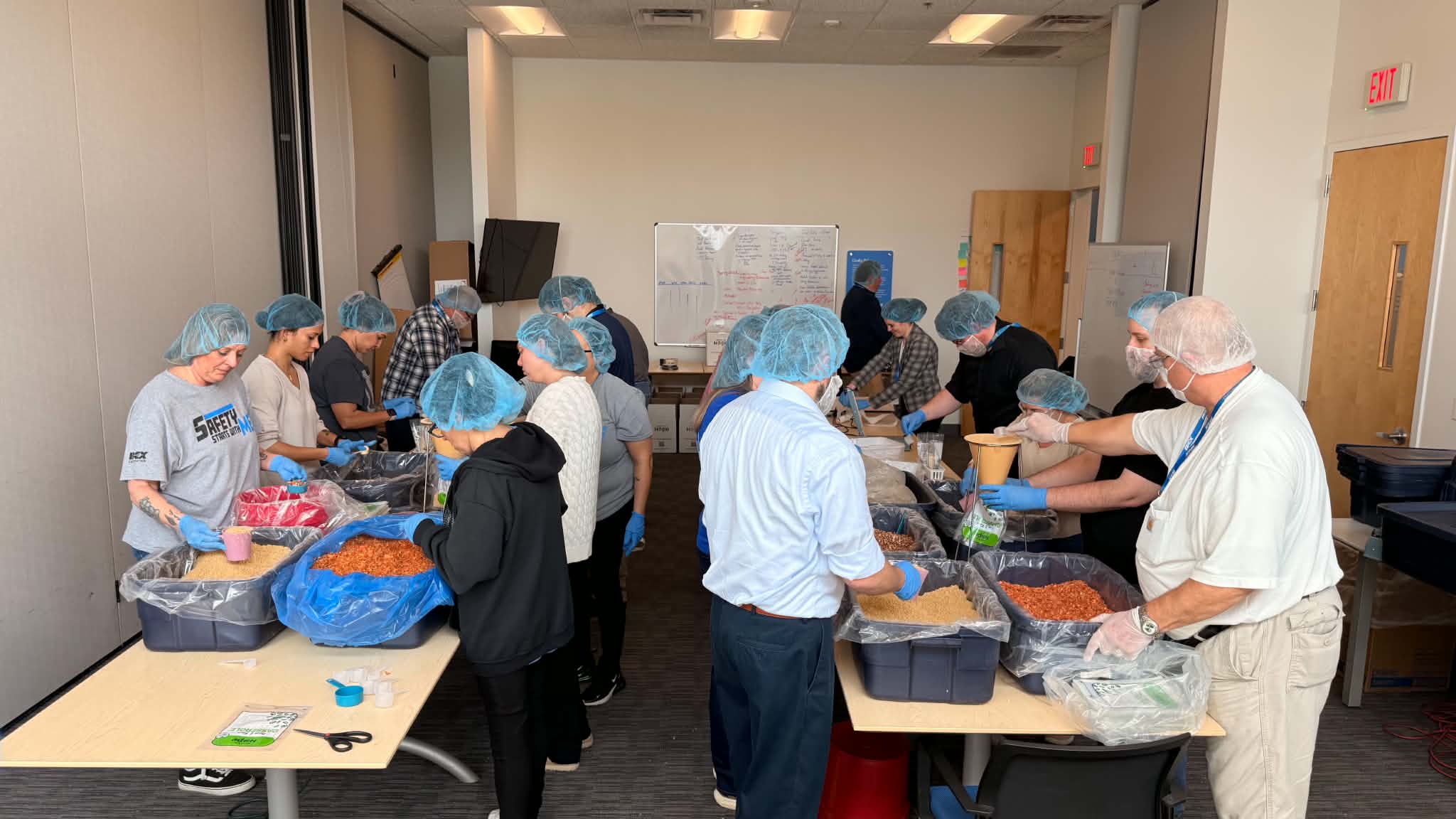
As the timer started and upbeat music filled the floor to establish a steady process rhythm, our volunteers quickly aced running a high-performing assembly line that required rapid, real-time iteration. Over the course of the day, 62 total volunteers rotated through the lines, uncovering vital Lean lessons in real-time:
To keep morale high and celebrate our incremental wins, a celebratory bell rang for every 1,000 completed meals before diving right back into the process.
Final Impact SummaryThrough the incredible hard work of our 62 volunteers throughout the day, we successfully packaged approximately ~14,700 total meals! Thanks to tight material controls and efficient scooping, we also yielded extra bulk bags of rice and beans, which are being donated directly to Foodlink alongside our primary inventory boxes.
Since our final tally of ~14,700 meals sat just slightly short of our stretch goal of 15,000—in true continuous improvement fashion—we paused to conduct a quick root-cause analysis. Our line hit a raw material constraint when we ran out of minced soy. Because keeping the exact, engineered recipe ratio is paramount to meal quality, we chose to stop packing once the soy was depleted rather than compromise on the bill of materials.
From an operations standpoint, this minor 2% yield variance represents a classic manufacturing variable. The root cause likely stems from minor tolerances: either the initial raw material bulk estimates from Meals of Hope had a small variance, or our teams were slightly over-serving on the ingredients. The margin between a perfectly flush, level scoop and a slightly rounded, heaping scoop is easily enough to account for a 2% volume shift over thousands of iterations.
But for Lean methodologies, zero waste is the goal, and no food went to waste! We immediately routed all remaining unopened bulk materials directly to Foodlink. As for the open bulk bags of rice and beans? We set them out into our employee lunchroom, and we are happy to report they vanished almost instantly!
Looking ahead, our team is already eager to host another meal-packing production event. We will actively use this 2% variance as an invaluable data point for our lessons learned, carrying it forward into our next iterative experiment in continuous improvement. Our completed, quality-certified meal shipments are transitioning directly to Foodlink to support regional neighborhoods and local families. A massive thank you to the IDEX Foundation for providing the $7,500 grant that funded this initiative, to Meals of Hope for their logistical and material support, and to every single volunteer who brought their energy, operational mindset, and passion to the line. Together, we proved that when Lean principles meet a community-first mission, we can systematically eliminate waste and eliminate hunger.