
Stories & Features

In optical system design, light is the currency you spend to get meaningful results, but etendue is your spending limit. Many system designers hit a technical wall where simply trying to deposit more laser power or buy a faster camera no longer yields results. This stagnation happens because the system's etendue has already capped how much information can actually be transferred.
To truly overcome these bottlenecks, we must look beyond individual components and consider the etendue conservation of the entire optical train.
Etendue (pronounced ay-tahn-doo) is a fundamental property of optics that characterizes how "spread out" the light is in both area and angle. Mathematically, it is the product of the area of the image and the solid angle that the focusing light subtends.
In an imaging system, three main components will each have a bearing on the overall etendue: the imaging optics, the sensor, and the illumination system. If any one of these is mismatched to the others, this results in wasted photons, poor image uniformity, and a system with ultimately lower efficiency and throughput.
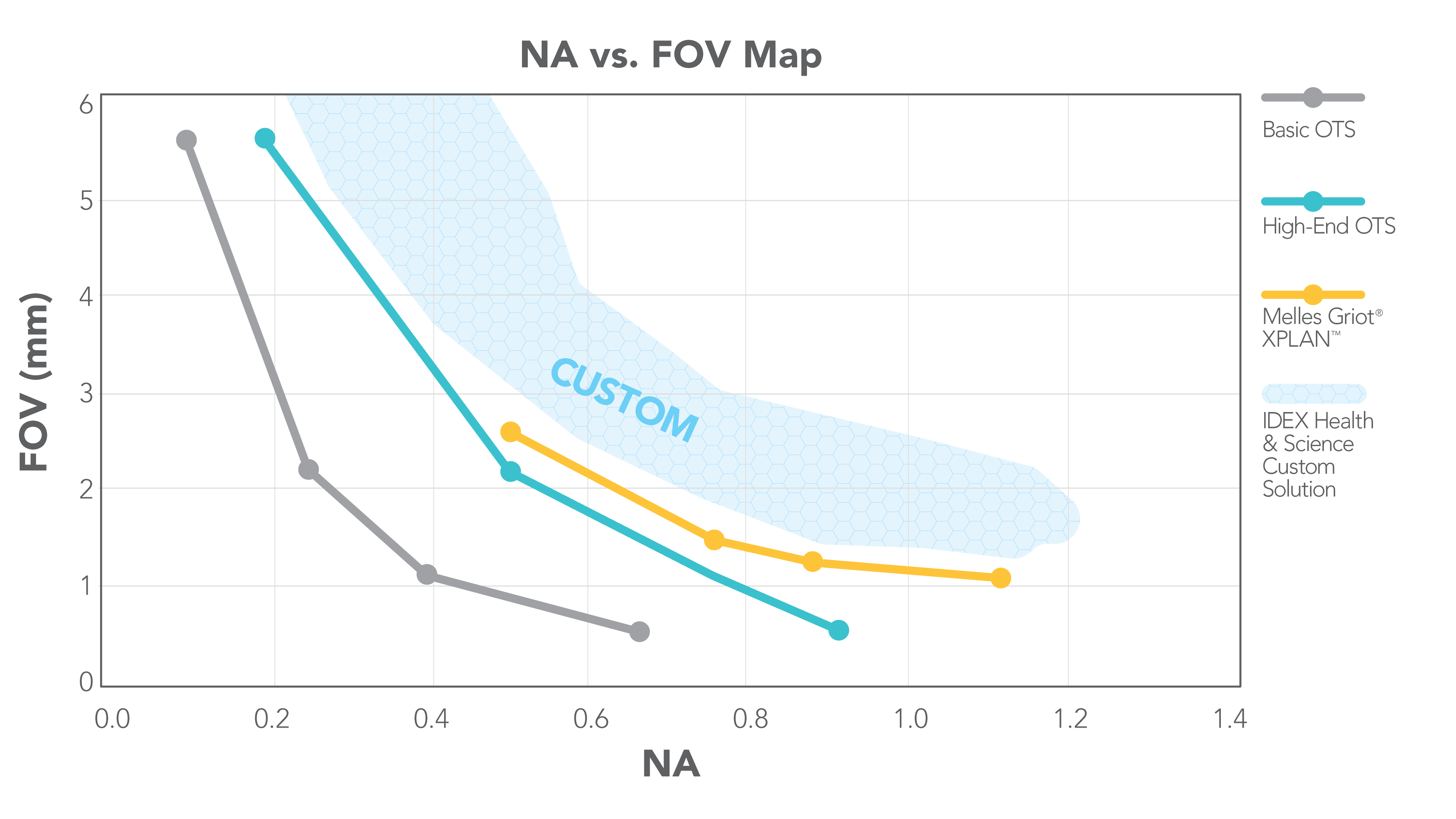
Where OTS objectives hit the NA–FOV wall, custom designs push etendue further.
Throughput is a direct consequence of the relationship between biology, optics, and data needs. When we optimize for higher and matched etendue within the system, the performance gains are measurable:
The Melles Griot XPLAN™ CCG Lens Series is a prime example of how we provide an etendue-matched service for our customers. While standard OTS objectives are often the pinch point for etendue in an instrument, the XPLAN CCG series is engineered to expand these limits:
Overcoming these challenges requires a holistic view of the optical path. By leveraging the expertise of Melles Griot Optical Systems from IDEX Health & Science, we provide a level of collaborative engineering that goes beyond simple component selection.
We don't just sell lenses; we provide the engineering partnership to align your system's etendue from source to sensor. By prioritizing etendue optimization through integrated Melles Griot solutions, we help you move from standard imaging to the high-throughput performance required for the future of biotech.
