

Hands-On Optics Challenges Inspire Future Scientists
Jul 1, 2026
by
IDEX Health & Science
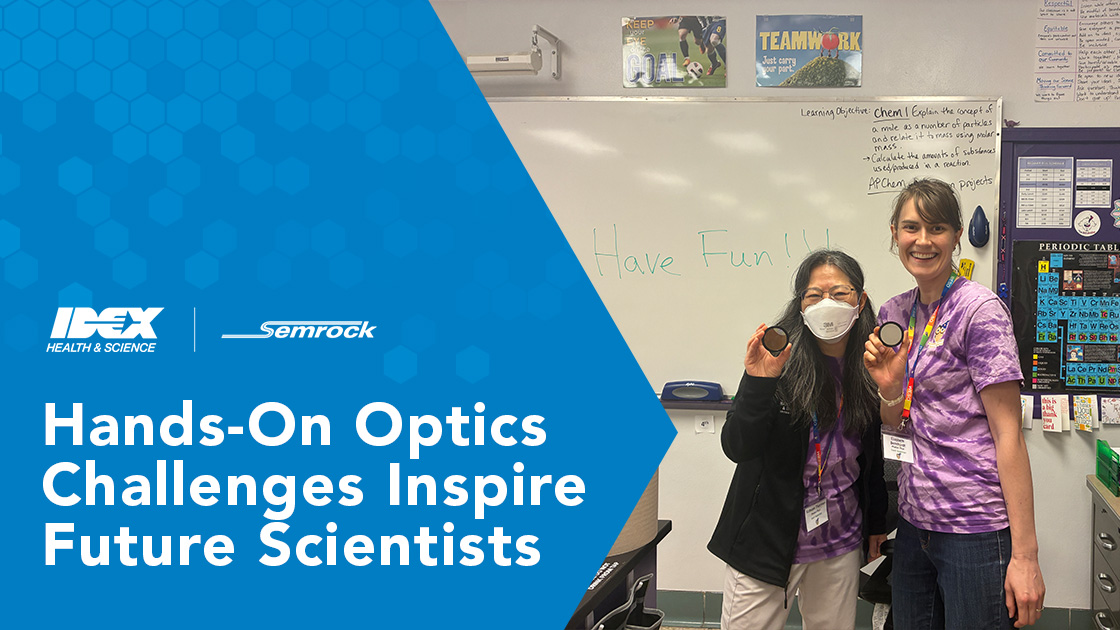
At this year’s Washtenaw Elementary Science Olympiad (WESO) 2026, students didn’t just learn about light. They reflected it, color mixed it, filtered it, and ultimately understood it.
Helping guide that experience was Elizabeth Bernhardt, PhD, an Application Scientist for IDEX Health & Science who volunteered as a supervisor for Photon Phun, a competitive, hands-on optics event for 4th and 5th grade students in southeast Michigan.
Turning Theory into Discovery
Photon Phun tests students’ understanding of light through experimentation, problem-solving, and teamwork. Teams of three start studying and experimenting ten weeks before the competition using educational resources and materials provided by WESO. Preparation is key to ensuring a high score in the event.
One highlight is a reflection relay in a dimly lit room. Teams use three mirrors to direct a light beam from a fixed source onto six targets in two minutes.
To succeed, students must apply key optics principles:
- Angle of incidence and reflection
- Mirror positioning and alignment
- Spatial reasoning under time pressure
With limited time to plan and act, the challenge pushes students to think critically and work together.
Beyond the Relay: Investigating Light Up Close
Outside the relay room, students complete hands-on experiments and written challenges covering:
- Color models such as RGB and CMYK
- Transparent, translucent, and opaque materials
- Additive and subtractive color behavior
- Wavelength, frequency, and the electromagnetic spectrum
A central part of the experience involved Semrock optical filters from IDEX Health & Science, giving students exposure to tools used in real scientific applications.
A Fourth-Grade “Aha” Moment
In one activity, students examined Semrock optical filters and were asked to interpret the meaning of a three-digit number printed on each ring (which the students did not know is the center wavelength of the passband). By shining light through the filters and observing the colors, they began forming hypotheses.
One particularly persistent team kept asking the supervisors questions, who could give limited answers to guarantee fairness for all the teams. Then came the breakthrough:
“Guys… IT’S NANOMETERS!”
They had correctly connected the numbers to wavelength, showing a strong grasp of how light is measured by scientists.
Fifth Graders Tackle Color Theory
Fifth-grade students worked with red, green, and blue filters and recorded their observations. At first glance, the filters appeared almost mirror-like. When light passed through them, distinct colors emerged. Next, students stacked filters to see what would happen.
Many had learned that red and green light combine to create yellow. However, stacking a red filter and then a green filter resulted in no light at all.
Students reasoned their way through the result:
- The red filter only allows red light to pass
- The green filter only allows green light to pass
- When a “sandwich” is created, no green light reaches the second filter, so no light emerges
One team asked Elizabeth why there was no light coming through, but she could not explain without giving away the answer. When she turned to help another team, one of the girls gasped and whispered, “I’ve got it! This is supposed to happen!” The team quickly scribbled their answer and high-fived. About three-quarters of the teams reached this conclusion, demonstrating understanding of how stacked filters “add” light the same way paint does – in a subtractive manner.
When Students Teach the Adults
One striking observation was how confidently students explained what they saw. According to Elizabeth, some adult volunteers found it challenging to articulate the same concepts, even with prior exposure to the material.
It served as a reminder: True understanding comes from hands-on experience.
Inspiring the Next Generation
Events like Photon Phun show the value of experiential STEM education. By combining competition with real-world application, students:
- Build confidence in problem-solving
- Develop scientific intuition
- Experience the excitement of discovery
For volunteers like Elizabeth, it is also an opportunity to give back and inspire future scientists.
Final Reflection
Inspiration does not always come from a lecture or a textbook.
Sometimes, it comes from a flashlight, three optical filters, and a student whispering:
“It’s nanometers.”