
Semrock Filters Don't Burn Out
All Semrock filters are hard coated with sophisticated Ion Beam Sputtering (IBS) technology, resulting in patented state-of-the-art filters with extremely durable hard glass coatings on a single hard glass substrate. No absorbing glass and no lamination is necessary. The result is exceptionally durable "no burn out" fluorescence filters of the highest performance.
Why replace low-durability soft-coated filters in fluorescence instruments?
Replacing aging soft-coated optical filters with Semrock® hard-coated optical filters can improve durability, spectral stability, and long-term imaging performance. Designed to withstand demanding operating environments, Semrock filters are widely recognized for fluorescence microscopy and analytical instrumentation applications because they combine high transmission, deep blocking, exceptional durability, and long-term spectral stability.
Even with the advances in IBS technology, the vast majority of optical filters in the field today are soft coated. Semrock's hard-coated filters have been tested to demonstrate their resistance to optical damage as compared to those of leading competitors' soft-coated and absorbing glass filters. The photographs below demonstrate how a conventional soft coated DAPI excitation filter burns out, while the hard coated BrightLine® DAPI filter is not affected by intense light sources, such as the mercury, xenon, and metal-halide lamps used in modern fluorescence imaging systems.
Both filters below were subjected to a Xe arc lamp at 8 W/cm2 for 1 day and then 1 W/cm2 continuously. The soft coated DAPI filter degraded rapidly and even cracked after less than 2 weeks of exposure, while the hard coated DAPI filter from Semrock continued to be unaffected after more than 1000 hours of continuous exposure.
Soft Coated DAPI Exciter Filter
< 300 Hours Exposure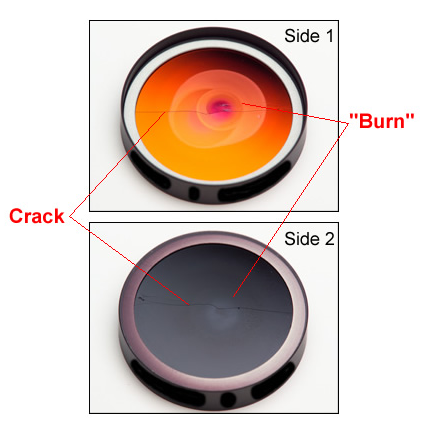
Semrock Hard-coated DAPI Exciter Filter
> 1000 Hours Exposure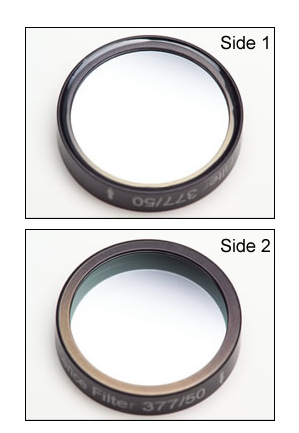
Upgrade from Soft-Coated to Hard-Coated Optical Filters
Many fluorescence instruments continue to rely on older soft-coated optical filters that can experience performance degradation from environmental exposure, cleaning cycles, high-intensity illumination, and long-term use. As instruments age, these changes may reduce image quality, decrease signal strength, and increase maintenance requirements.
Replacing low-durability soft-coated filters with modern hard-coated optical filters can help improve:
- Filter longevity
- Environmental stability
- Laser damage resistance
- Spectral consistency
- Instrument uptime
- Total cost of ownership
Hard-coated optical filters are constructed using durable dielectric coating technologies that resist humidity, temperature changes, and physical wear. Because the spectral characteristics remain stable over time, instrument developers and end users can maintain more consistent imaging performance throughout the lifecycle of the system.
For OEM manufacturers evaluating redesigns or component upgrades, replacing soft-coated filters is often one of the most effective methods for improving fluorescence instrument reliability without requiring major changes to the optical architecture.
The graphs below show how the exposure affected the spectral properties of each filter. After the first day, the soft coated DAPI filter's transmission dropped by 42%. We similarly tested other common exciter filters and found that each soft coated filter experienced loss of transmission and passband shift, while the hard coated Semrock filters remain unaffected.
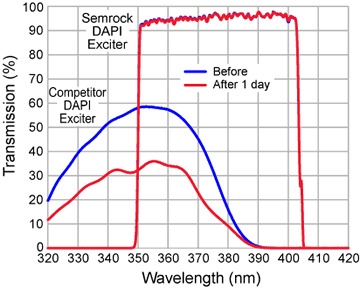
Transmission spectra of DAPI exciters before (blue) and after (red) exposure to 8 W/cm2 (over 15 mm diameter) for 1 day.
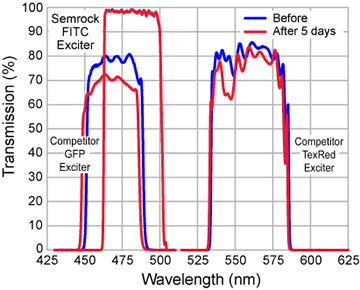
Transmission spectra of soft-coated exciters (for GFP and Texas Red) compared to a Semrock hard-coated exciter (for FITC) before (blue) and after (red) exposure to 1 W/cm2 (over 25 mm diameter) for 5 days.
FAQs
Why should I replace soft-coated optical filters?
Soft-coated filters may be more susceptible to environmental degradation and performance drift over time. Replacing them with hard-coated alternatives can improve durability, reliability, and long-term optical performance.
How do hard-coated filters improve fluorescence instrument performance?
Hard-coated filters maintain stable spectral characteristics under demanding operating conditions, helping preserve image contrast, signal quality, and measurement consistency.
When should fluorescence microscope filters be replaced?
Filters should be evaluated when imaging performance declines, transmission characteristics change, coatings become damaged, or instrument upgrades require improved optical performance.